Hubble image archive
Omega Centauri Context Image
Although models suggest globular star cluster Omega Centauri should contain approximately 10,000 stellar-mass black holes, observational evidence of their existence has remained scarce.A team of astronomers recently tracked the position of stars on the sky over more than 20 years...
- Date
- Sep 8, 2026
- Mission
- Hubble Space Telescope
- Archive ID
- omega-centauri-context-image
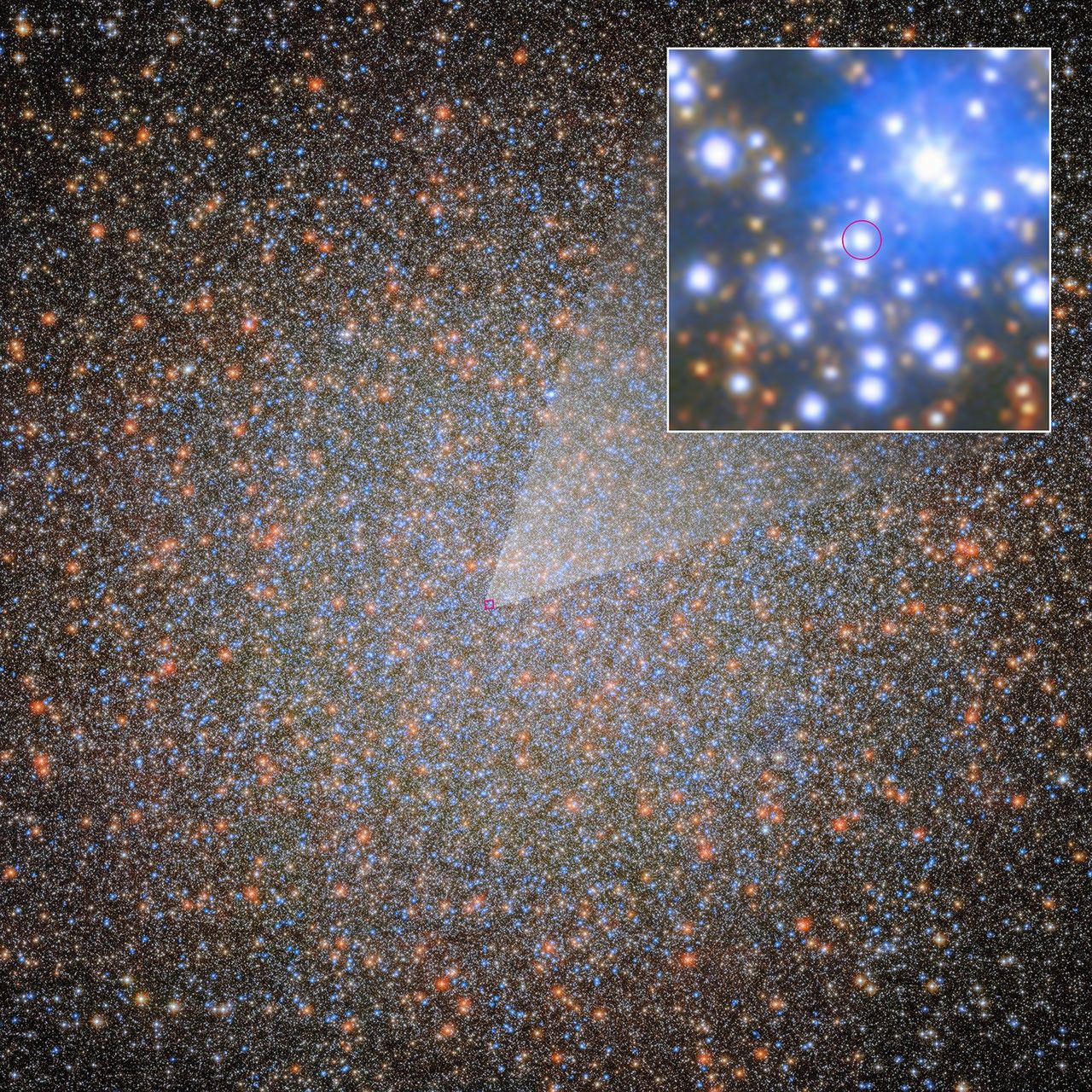
Although models suggest globular star cluster Omega Centauri should contain approximately 10,000 stellar-mass black holes, observational evidence of their existence has remained scarce.
A team of astronomers recently tracked the position of stars on the sky over more than 20 years using a robust multi-mission dataset of archival data from NASA’s Hubble Space Telescope as well as recent data from NASA’s James Webb Space Telescope. Based on their analysis, the science team detected a visible main sequence star orbiting a stellar-mass black hole. The main sequence star companion is encircled and shown in greater detail in the pullout in the top-right corner. The stellar-mass black hole, called oMEGACat BH-2, is the first of its kind found in Omega Centauri.
Its discovery sparks many questions surrounding the physics and formation of stellar-mass black holes within globular star clusters, and strengthens the need for follow-up studies of Omega Centauri and investigations into similar environments.
Image Details
About the Object
| R.A. Position | 13:26:46.27 |
|---|---|
| Dec. Position | -47:28:25.51 |
| Constellation | Centaurus |
| Distance | 17000 light-years |
About the Data
| Instrument | WFC3; ACS |
|---|---|
| Filters | WFC3: F275W, F336W, F438W, F606W, F625W, F658N, F814W ACS: F435W, F606W, F814W |
More Images From This Period
Downloads
Source
Image and source material are credited to the official mission archive linked below.
View on NASA.gov