Hubble image archive
Saturn (Webb NIRCam Image)
This infrared view of Saturn was captured Nov. 29, 2024, by NASA’s James Webb Space Telescope. Observing the planet in infrared wavelengths allows Webb to reveal details of Saturn’s atmosphere and rings that can’t be seen in visible light. In this view, Saturn’s rings appear exce...
- Date
- Sep 8, 2026
- Mission
- Hubble Space Telescope
- Archive ID
- saturn-webb-nircam-image
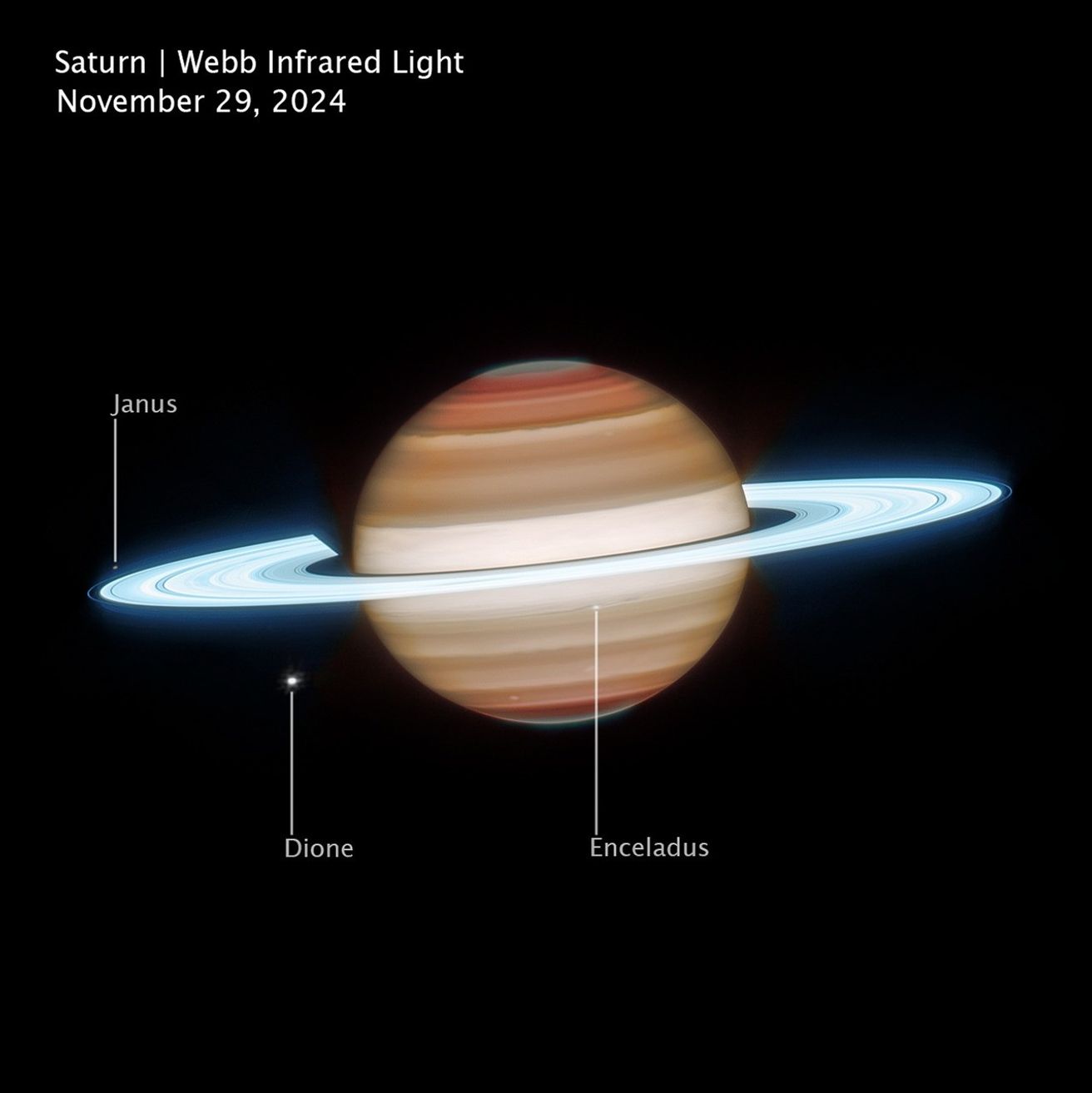
This infrared view of Saturn was captured Nov. 29, 2024, by NASA’s James Webb Space Telescope. Observing the planet in infrared wavelengths allows Webb to reveal details of Saturn’s atmosphere and rings that can’t be seen in visible light. In this view, Saturn’s rings appear exceptionally bright because they are composed largely of highly reflective water-ice particles that efficiently scatter sunlight.
Infrared observations also highlight structure in Saturn’s atmosphere, including broad cloud bands and subtle variations caused by temperature differences, winds, and high-altitude hazes. Webb’s sensitivity to infrared light allows scientists to probe different layers of the atmosphere, helping researchers study how gases, clouds, and aerosols interact across multiple altitudes. These observations provide new insight into the planet’s complex weather patterns and atmospheric dynamics.
Several of Saturn’s moons are visible in this image. Janus appears near the rings to the left of the planet, while Dione is visible below as a bright point of light. On the right side of the image, Enceladus appears near the rings. Enceladus is of particular scientific interest because it harbors a subsurface ocean beneath its icy crust and ejects plumes of water vapor and ice grains into space from fractures near its south pole.
Image Details
About the Data
| Data Description | These images were created with Webb data from proposal: 9219 (M. Garcia Marin) |
|---|---|
| Instrument | NIRCam |
| Exposure Dates | November 29, 2024 |
| Filters | F164N, F212N, F430M, F470N |
More Images From This Period
Downloads
Source
Image and source material are credited to the official mission archive linked below.
View on NASA.gov