Hubble image archive
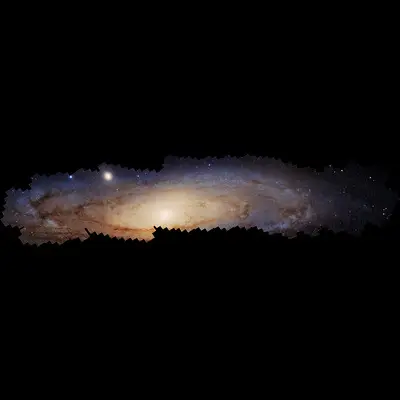
Compass and Scale Image of M31 PHAT+PHAST Mosaic
Caption This is the largest photomosaic ever made by the Hubble Space Telescope. The target is the vast Andromeda galaxy that is only 2.5 million light-years from Earth, making it the nearest galaxy to our own Milky Way. Andromeda is seen almost edge-on, tilted by 77 degrees rela...
- Date
- Jan 16, 2025
- Mission
- Hubble Space Telescope
- Archive ID
- hubblesite-images-2025-005-01jgycdxbecn5d71z6cxat7k5c

Caption
This is the largest photomosaic ever made by the Hubble Space Telescope. The target is the vast Andromeda galaxy that is only 2.5 million light-years from Earth, making it the nearest galaxy to our own Milky Way. Andromeda is seen almost edge-on, tilted by 77 degrees relative to Earth’s view. The galaxy is so large that the mosaic is assembled from approximately 600 separate overlapping fields of view taken over 10 years of Hubble observing—a challenge to stitch together over such a large area. The mosaic image is made up of at least 2.5 billion pixels. Hubble resolves an estimated 200 million stars that are hotter than our Sun, but still a fraction of the galaxy’s total estimated stellar population.
Interesting regions include: (a) Clusters of bright blue stars embedded within the galaxy, background galaxies seen much farther away, and photo-bombing by a couple bright foreground stars that are actually inside our Milky Way; (b) NGC 206 the most conspicuous star cloud in Andromeda; (c) A young cluster of blue newborn stars; (d) The satellite galaxy M32, that may be the residual core of a galaxy that once collided with Andromeda; (e) Dark dust lanes across myriad stars.
More Images From This Period
Downloads
Source
Image and source material are credited to the official mission archive linked below.
View on NASA.gov