Hubble image archive
The Illusion of a Continuous Perseus Arm
In a map of the Milky Way, the neighboring spiral arm just beyond the Sun is known as the Perseus arm. Astronomers created this map by measuring the locations of natural radio sources known as masers (pink dots in pullouts at right) and dust clouds (blue dots). At upper right, a...
- Date
- Jan 1, 2021
- Mission
- Hubble Space Telescope
- Archive ID
- hubblesite-images-2021-061-01fpj6chsm97vhr4ywmx45sn14
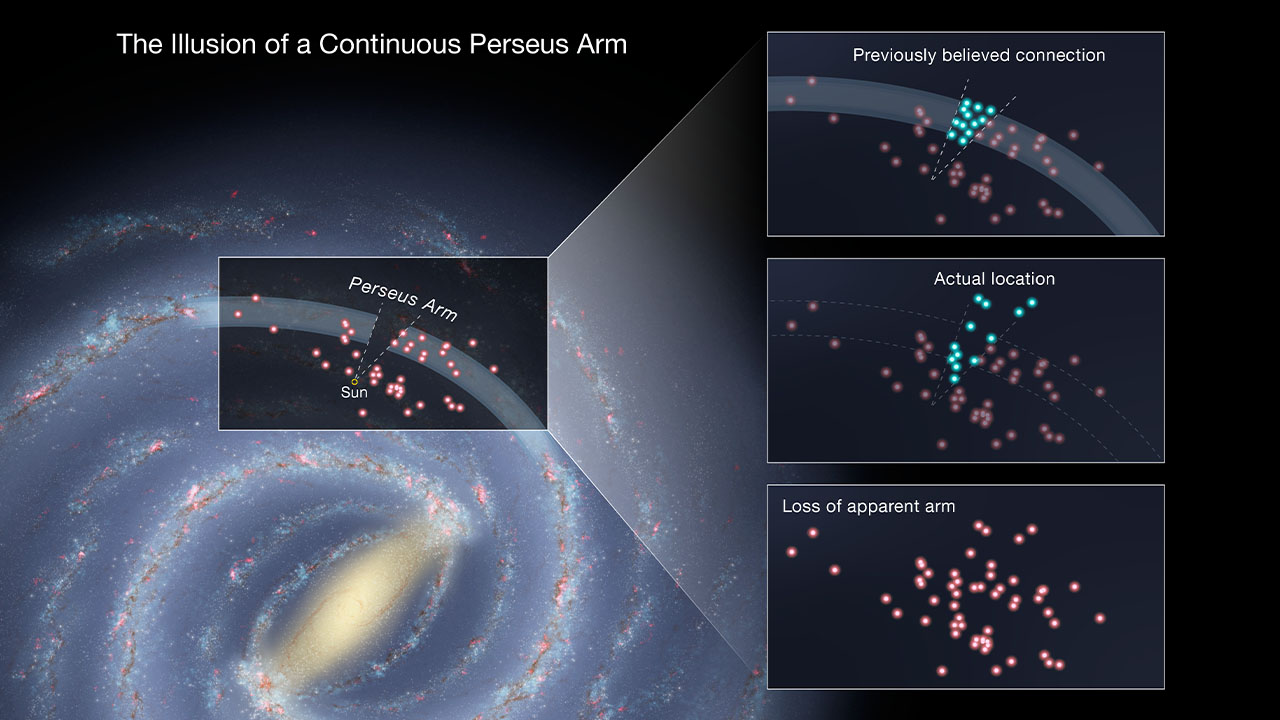
In a map of the Milky Way, the neighboring spiral arm just beyond the Sun is known as the Perseus arm. Astronomers created this map by measuring the locations of natural radio sources known as masers (pink dots in pullouts at right) and dust clouds (blue dots). At upper right, a shaded region shows the previously believed shape of the Perseus arm, demarcated by a combination of masers and dust clouds. New measurements (middle right) show that some of these dust clouds are much closer or farther from the Sun than originally thought. As a result, the Perseus arm may be much clumpier and less well-defined (lower right).
Credits
Science
Joshua Peek (STScI)
Illustration
Robert L. Hurt (Caltech, IPAC), Leah Hustak (STScI)
More Images From This Period
Source
Image and source material are credited to the official mission archive linked below.
View on NASA.gov