Hubble image archive
Spectra of Galaxies within the Hubble Ultra Deep Field
This Hubble image features four of the thousands of galaxies found within the Hubble Ultra Deep Field. All of the highlighted galaxies show evidence of vigorous star formation (blue regions filled with hot, young stars). In the insets at right, the near-infrared spectrum of each...
- Date
- Jan 1, 2022
- Mission
- Hubble Space Telescope
- Archive ID
- hubblesite-images-2022-018-01g406hawzmfmwztnk61c7c5je
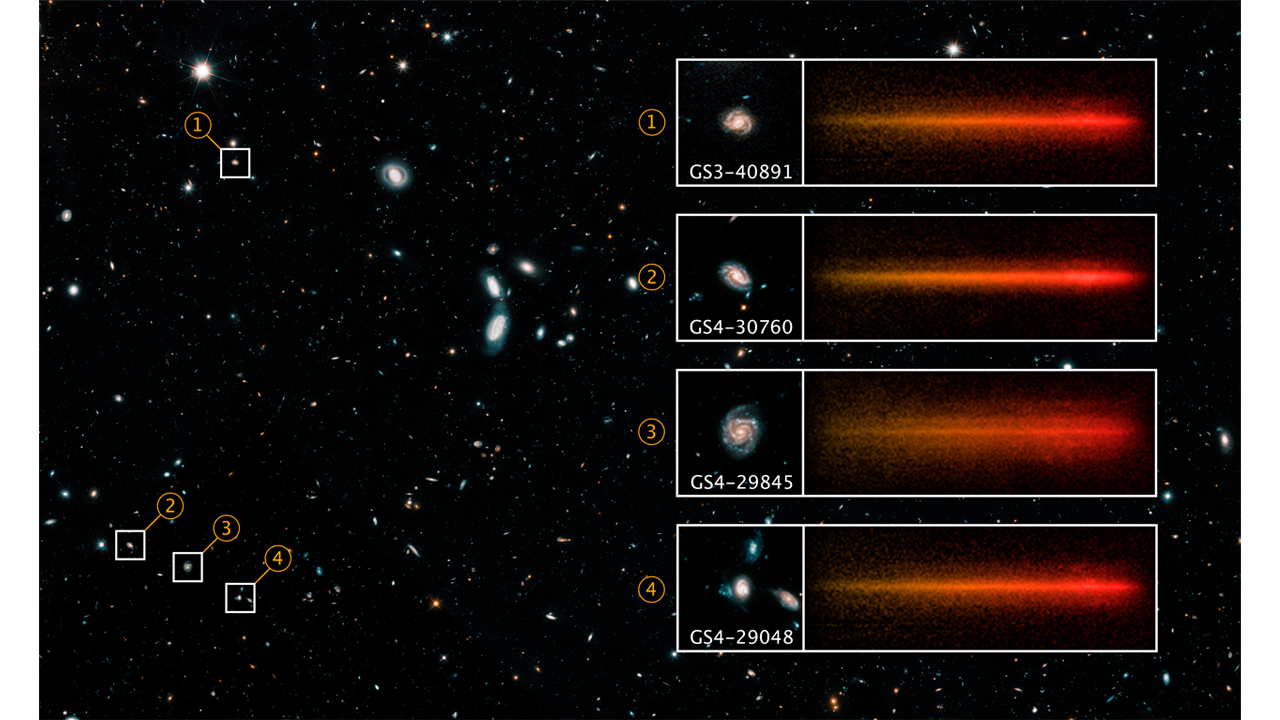
This Hubble image features four of the thousands of galaxies found within the Hubble Ultra Deep Field. All of the highlighted galaxies show evidence of vigorous star formation (blue regions filled with hot, young stars). In the insets at right, the near-infrared spectrum of each galaxy is displayed. By examining a galaxy’s spectrum, you can learn about the ages of its stars, its star-formation history, how many heavy chemical elements it contains, and more.
Upon entering operations in 2027, the Nancy Grace Roman Space Telescope will be able to collect spectra for every object in its field of view, which is 200 times larger than Hubble’s in infrared light. As a result, it will enable studies of rare galaxies from a period known as “cosmic noon,” when many galaxies went through growth spurts.
Credits
Science
NASA, ESA, STScI, Casey Papovich (TAMU)
Image Processing
Alyssa Pagan (STScI)
Image Details
| About The Object | |
|---|---|
| Object Name | HLF; GS3-40891; GS4-30760; GS4-29845; GS4-29048 |
| Object Description | Deep field with spectra of starburst galaxies |
| R.A. Position | 3:32:29 |
| Dec. Position | -27:49:12 |
| Constellation | Fornax |
| About The Data | |
| Data Description | Image: The HLF image was created from public archive Hubble data from the following proposals: , , , , and : A. Riess (STScI/JHU); : M. Giavalsco (University of Massachusetts); , and : J. Rhodes (JPL); : K. Ratnatunga (Carnegie Mellon University); : H. Rix (MPE) : W. Sparks (STScI); , , and : S. Malhotra (Arizona State University); : R. Thompson (University of Arizona) and : S. Beckwith (STScI); : C. Kretchmer (JHU); : M. Stiavelli (STScI); R. Bouwens (Universiteit Leiden); : R. O'Connell (University of Virginia); , and 12007: G. Illingworth (University of California, Santa Cruz); , , and : S. Faber (University of California, Santa Cruz); : P. van Dokkum (Yale University). : R. Ellis (University College London) : H. Teplitz (California Institute of Technology) : M. Swinbank (Durham University) : A. Muzzin (York University) : P. Oesch (Observatoire de Geneve) : E. Vanzella (INAF) The HLF team members include: G. Illingworth and D. Magee (University of California, Santa Cruz), K. Whitaker (University of Connecticut), R. Bouwens (Leiden University), P. Oesch (University of Geneva), P. van Dokkum (Yale University), I. Labbe (Swinburne University), B. Holden (University of California, Santa Cruz), M. Franx (Leiden University), and V. Gonzalez (Universidad de Chile). Spectra: The Hubble image(spectra) was created from HST data from proposal: (C. Papovich). |
| Instrument | ACS/WFC, WFC3/IR, WFC3/UVIS |
| Filters | WFC3/UV (F225W, F275W, and F336W); ACS (F435W, F606W, F775W, F814W, and F850LP); WFC3/IR (G102, F098M, F105W, F125W, F140W, and F160W) |
| About The Image | |
| Color Info | IMAGE: These images are composites of separate exposures acquired by the ACS and WFC3 instruments on the Hubble Space Telescope. Several filters were used to sample broad and narrow wavelength ranges. The color results from assigning different hues (colors) to each monochromatic (grayscale) image associated with an individual filter. In this case, the assigned colors are: Blue: F606W (Wide V) Green: F606W (Wide V) and F850LP (SDSS z') Red: F850LP (SDSS z') SPECTRA: The spectra is created from exposures from the WFC3/IR instrument using a grism. A color map from yellow to red is applied to the spectra which corresponds to increasing wavelength. |
Downloads
Source
Image and source material are credited to the official mission archive linked below.
View on NASA.gov