Hubble image archive
Brown Dwarf 2M1207A and Companion
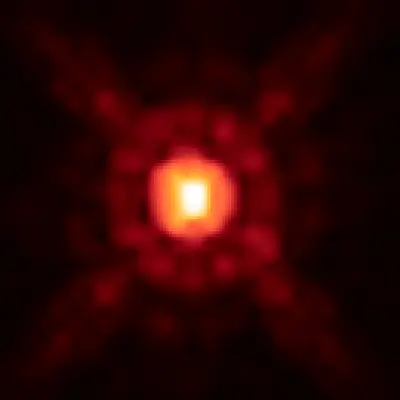
[Left] – This is a Hubble Space Telescope near-infrared-light image of a brown dwarf located 170 light-years away from Earth. The object is no more than 30 times the mass of Jupiter, making it too small to sustain nuclear fusion to shine as a star.[Right] – When the glow of the b...
- Date
- Jan 1, 2016
- Mission
- Hubble Space Telescope
- Archive ID
- hubblesite-images-2016-05-3702-image

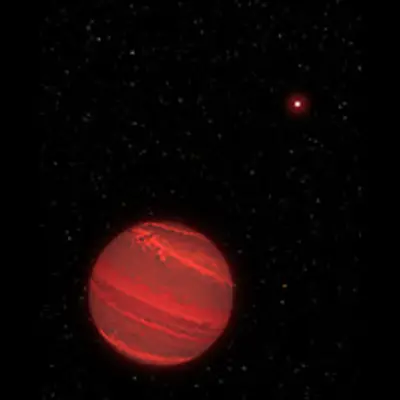
[Left] – This is a Hubble Space Telescope near-infrared-light image of a brown dwarf located 170 light-years away from Earth. The object is no more than 30 times the mass of Jupiter, making it too small to sustain nuclear fusion to shine as a star.
[Right] – When the glow of the brown dwarf is subtracted from the image, a smaller and fainter companion object becomes visible. No more that four times the mass of Jupiter, this companion is dubbed a "super-Jupiter." It has an estimated diameter as big as 40 percent greater than Jupiter's diameter. The world is 5 billion miles from the brown dwarf, nearly twice the distance between our sun and the planet Neptune.
Because the planet is only 10 million years old, it is so hot it may rain molten glass and iron in its atmosphere. Hubble has measured fluctuations in the planet's brightness that suggests the planet has patchy clouds as it completes one rotation every 10 hours.
Credits
NASA, ESA, and Y. Zhou (University of Arizona)Image Details
| About The Object | |
|---|---|
| Object Name | 2M1207, 2MASS J12073346-3932539, 2M1207A and 2M1207b |
| Object Description | Super-Jupiter around a Brown Dwarf |
| R.A. Position | 12h 7m 33.46s |
| Dec. Position | 39° 32' 53.99" |
| Constellation | Centaurus |
| Distance | 170 light-years (52.4 parsecs) |
| About The Data | |
| Data Description | The HST data were taken from proposals 13418: D. Apai, and G. Schneider (Steward Observatory/University of Arizona), M. Kasper (European Southern Observatory, Germany), A. Showman (University of Arizona), and M. Marley (NASA Ames Research Center). The science team comprises :Y. Zhou, D. Apai, and G. Schneider (Steward Observatory/University of Arizona), M. Marley (NASA Ames Research Center), and A. Showman (University of Arizona). |
| Instrument | HST>WFC3/IR |
| Exposure Dates | April 11, 2014 |
| Filters | F125W (J) and F160W (H) |
| About The Image | |
| Color Info | This image was originally black and white and recorded only overall brightness from the F160W (H) filter. These brightness values were translated into a range of reddish hues. Such color "maps" can be useful in helping to distinguish subtly varying brightness in an image. |
Downloads
Source
Image and source material are credited to the official mission archive linked below.
View on NASA.gov