Hubble image archive
Hubble/Subaru Composite Image of Star-Forming Region S106
Hubble Space Telescope's high resolution combines with the Subaru Telescope's wide field-of-view to reveal a depiction of star-forming region S106 that is not possible from either telescope alone. The bipolar S106 shows bright gas in two distinct lobes. The faint stars located ne...
- Date
- Jan 1, 2011
- Mission
- Hubble Space Telescope
- Archive ID
- hubblesite-images-2011-38-2934-image
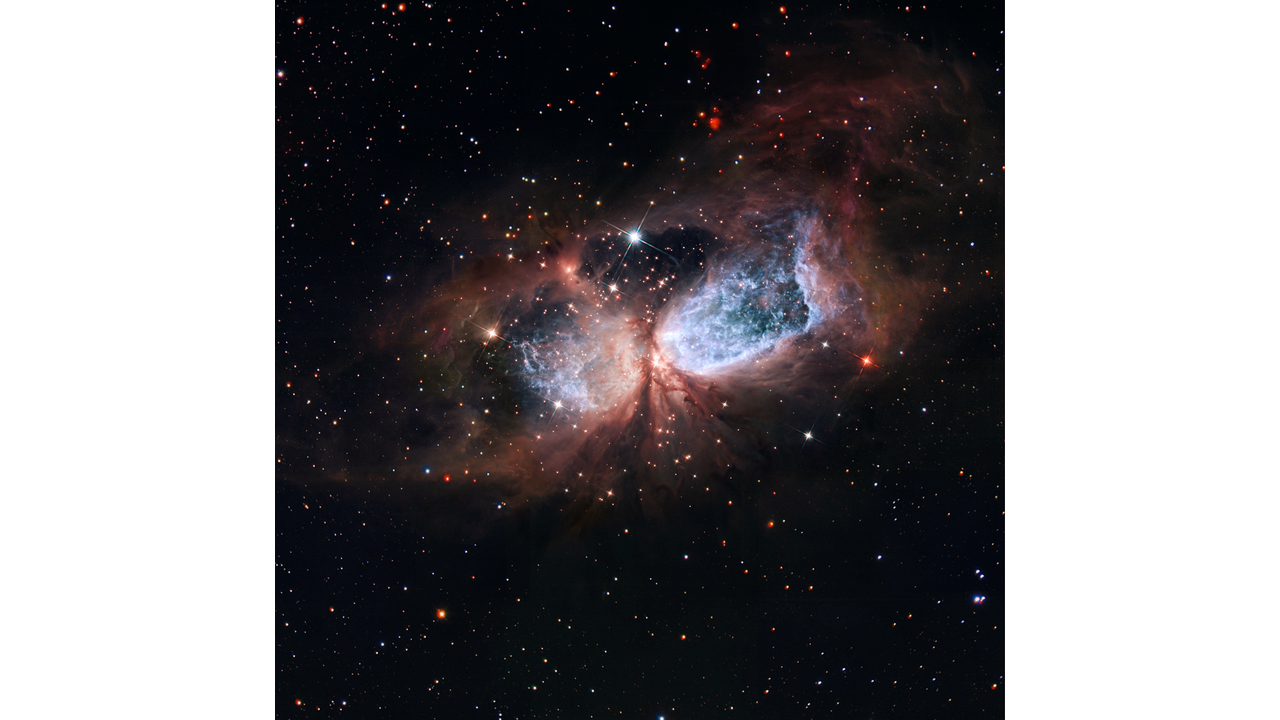
Hubble Space Telescope's high resolution combines with the Subaru Telescope's wide field-of-view to reveal a depiction of star-forming region S106 that is not possible from either telescope alone. The bipolar S106 shows bright gas in two distinct lobes. The faint stars located near the nebulosity are brown dwarf candidates associated with the region of star formation.
This composite image combines optical and near-infrared astronomical data from the Hubble Space Telescope with mid-infrared data from the ground-based Subaru Telescope, located on Mauna Kea in Hawaii. The Hubble data (H-alpha, J, and H) were taken as part of Hubble Heritage observations of S106 in February 2011. The Subaru data (J, H, and K) were obtained in May 1999.
Credits
NASA, ESA, the Hubble Heritage Team (STScI/AURA), and the Subaru Telescope (National Astronomical Observatory of Japan)Image Details
| About The Object | |
|---|---|
| Object Name | S106, Sh2-106, Sharpless 2-106 |
| Object Description | Star-Forming Region |
| R.A. Position | 20h 27m 27.09s |
| Dec. Position | 37° 22' 39.0" |
| Constellation | Cygnus |
| Distance | About 2000 light-years (600 parsecs) |
| About The Data | |
| Instrument | Subaru, HST>WFC3/UVIS and HST>WFC3/IR |
| Exposure Dates | May 1999 |
| Filters | Subaru: ((J), (H), and (K); WFC3/UVIS: F657N (H-alpha) WFC3/IR: F110W (J) and F160W (H) |
Downloads
Source
Image and source material are credited to the official mission archive linked below.
View on NASA.gov