Hubble image archive
Annotated Illustration of Fomalhaut System
This image, taken with the Advanced Camera for Surveys aboard NASA's Hubble Space Telescope, shows the newly discovered planet, Fomalhaut b, orbiting its parent star, Fomalhaut.The small white box at lower right pinpoints the planet's location. Fomalhaut b has carved a path along...
- Date
- Jan 1, 2008
- Mission
- Hubble Space Telescope
- Archive ID
- hubblesite-images-2008-39-2428-image

This image, taken with the Advanced Camera for Surveys aboard NASA's Hubble Space Telescope, shows the newly discovered planet, Fomalhaut b, orbiting its parent star, Fomalhaut.
The small white box at lower right pinpoints the planet's location. Fomalhaut b has carved a path along the inner edge of a vast, dusty debris ring encircling Fomalhaut that is 21.5 billion miles across. Fomalhaut b lies 1.8 billion miles inside the ring's inner edge and orbits 10.7 billion miles from its star.
The inset at bottom right is a composite image showing the planet's position during Hubble observations taken in 2004 and 2006. Astronomers have calculated that Fomalhaut b completes an orbit around its parent star every 872 years.
The white dot in the center of the image marks the star's location. The region around Fomalhaut's location is black because astronomers used the Advanced Camera's coronagraph to block out the star's bright glare so that the dim planet could be seen. Fomalhaut b is 1 billion times fainter than its star. The radial streaks are scattered starlight. The red dot at lower left is a background star.
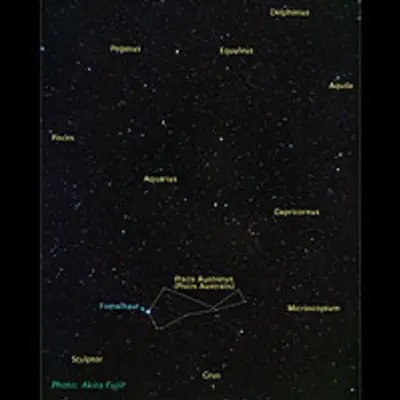
The Fomalhaut system is 25 light-years away in the constellation Piscis Australis.
This false-color image was taken in October 2004 and July 2006.
Credits
NASA, ESA, and Z. Levay (STScI)Image Details
| About The Object | |
|---|---|
| Object Name | Fomalhaut, HD 216956, Fomalhaut b |
| Object Description | Exoplanet Orbiting Fomalhaut |
| R.A. Position | 22h 57m 39.04s |
| Dec. Position | -29° 37' 20.04" |
| Constellation | Piscis Austrinus |
| Distance | 25 light-years (8 parsecs) |
| Dimensions | This image is roughly 375 AU (49 arcseconds) wide. |
| About The Data | |
| Data Description | HST Proposal: P. Kalas and J. Graham (University of California, Berkeley) and M. Clampin (NASA Goddard Space Flight Center); and : P. Kalas, J. Graham, and E. Chiang (University of California, Berkeley), M. Clampin (NASA Goddard Space Flight Center), and K. Stapelfeldt and J. Krist (NASA Jet Propulsion Laboratory). The science team includes: P. Kalas and E. Chiang (University of California, Berkeley), M. Fitzgerald (Lawrence Livermore National Laboratory), M. Clampin (NASA Goddard Space Flight Center), E. Kite (University of California, Berkeley), J. Krist and K. Stapelfeldt (NASA Jet Propulsion Laboratory), and J. Graham (University of California, Berkeley). |
| Instrument | HST>ACS/HRC |
| Exposure Dates | October 2004 and July 2006, Exposure Time: 11.4 hours |
| Filters | F435W (B), F606W (V), and F814W (I) |
More Images From This Period
Downloads
Source
Image and source material are credited to the official mission archive linked below.
View on NASA.gov