Hubble image archive
Close-up of "Proplyds" in the Orion Nebula
A Hubble Space Telescope view of a small portion of the Orion Nebula reveals five young stars. Four of the stars are surrounded by gas and dust trapped as the stars formed, but were left in orbit about the star. These are possibly protoplanetary disks, or "proplyds," that might e...
- Date
- Jan 1, 1994
- Mission
- Hubble Space Telescope
- Archive ID
- hubblesite-images-1994-24-165-image
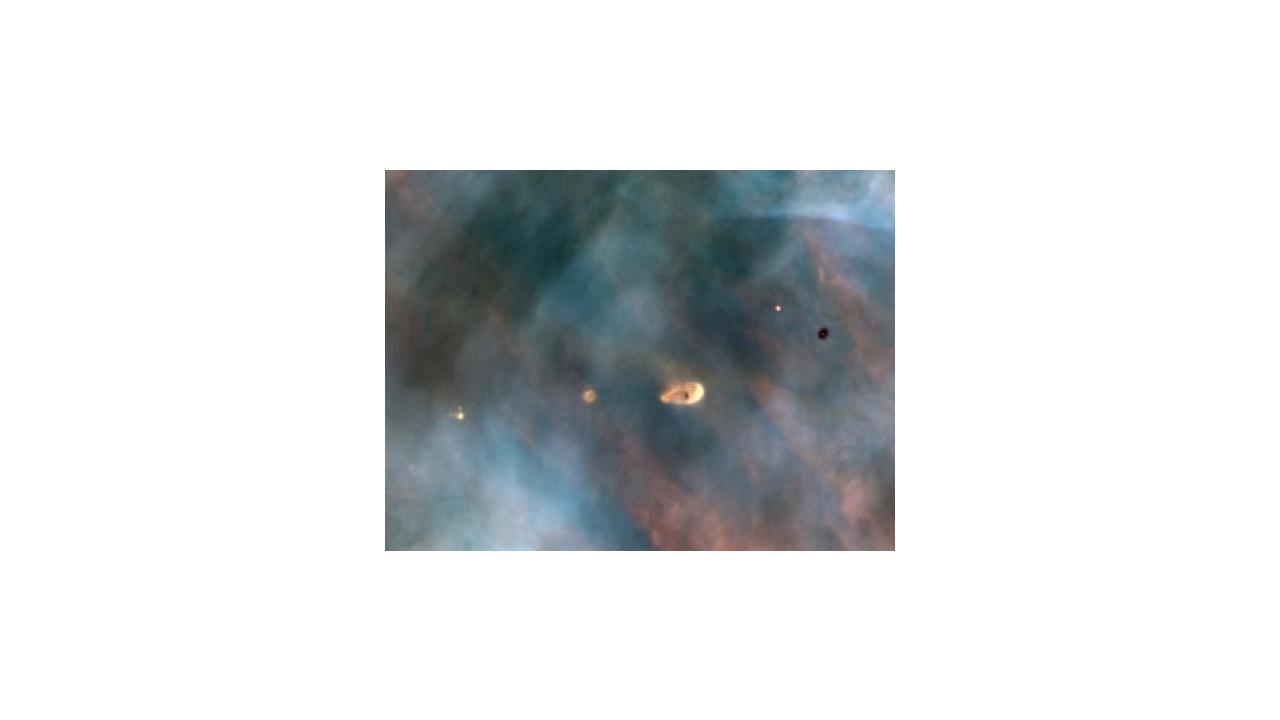
A Hubble Space Telescope view of a small portion of the Orion Nebula reveals five young stars. Four of the stars are surrounded by gas and dust trapped as the stars formed, but were left in orbit about the star. These are possibly protoplanetary disks, or "proplyds," that might evolve on to agglomerate planets. The proplyds which are closest to the hottest stars of the parent star cluster are seen as bright objects, while the object farthest from the hottest stars is seen as a dark object. The field of view is only 0.14 light-years across. The Orion Nebula star-birth region is 1,500 light-years away, in the direction of the constellation Orion the Hunter. The image was taken on 29 December 1993 with the HST's Wide Field and Planetary Camera 2.
Credits
Credit: C.R. O'Dell/Rice University; NASAImage Details
| About The Object | |
|---|---|
| Object Name | Orion Nebula, M42, NGC 1976 |
| R.A. Position | 05h 35m 17.29s |
| Dec. Position | -5° 23' 27.99" |
Downloads
Source
Image and source material are credited to the official mission archive linked below.
View on NASA.gov