Hubble image archive
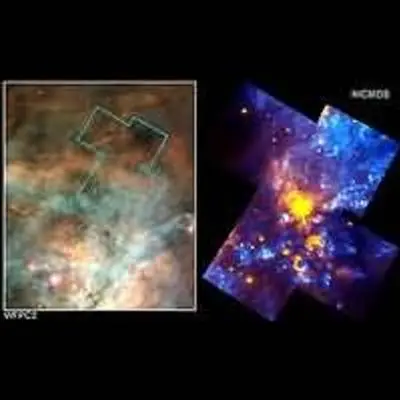
Eagle Nebula with a representation of a giant molecular cloud
Shown here HST image of Eagle Nebula with part of its associated GMC. Since molecular hydrogen gas can only be observed by radio technique, contour lines are here used to show where the optically invisible hydrogen gas lies. The manner in which GMCs form stars may strongly depend...
- Date
- Jan 1, 1997
- Mission
- Hubble Space Telescope
- Archive ID
- hubblesite-images-1997-34-531-image

Shown here HST image of Eagle Nebula with part of its associated GMC. Since molecular hydrogen gas can only be observed by radio technique, contour lines are here used to show where the optically invisible hydrogen gas lies. The manner in which GMCs form stars may strongly depend on environment. In Milky Way, stars form slowly, soon disrupt and disperse molecular gas around them, as seen here in Eagle Nebula. In merging galaxies experiencing vast bursts of star formation, the fate of a GMCs may be quite different. As tenuous gas surrounding these clumps of dense molecular gas heast up, GMCs may get crunched and triggered into rapidly forming stars. The process may be so rapid that the new stars do not have time to disrupt the GMCs before nearly all the gas is used up. The result is that GMCs may turn into rich star clusters that evolve into globular clusters.
Credits
Image: NASA, ESA, STScI, and J. Hester and P. Scowen (Arizona State University);Radio contour: Leo Blitz (UCB), image - Jeff Hester & Paul Scowen (ASU)
Image Details
| About The Object | |
|---|---|
| Object Name | Eagle Nebula |
| Object Description | Emission Nebula |
| R.A. Position | 18h 18m 48.17s |
| Dec. Position | -13° 48' 26.03" |
| Constellation | Serpens |
| Distance | 6,500 light-years (2,000 parsecs) |
| About The Data | |
| Instrument | HST>WFPC2 |
| Exposure Dates | April 1, 1995 |
Source
Image and source material are credited to the official mission archive linked below.
View on NASA.gov