Hubble image archive
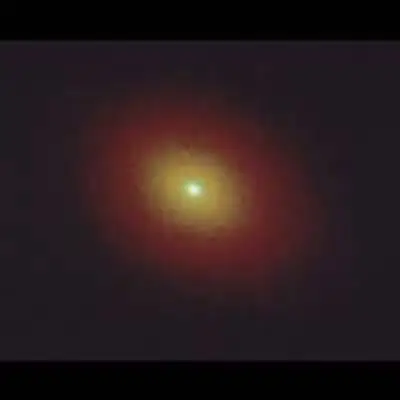
Close-up of Three Protoplanetary Disks in the Orion Nebula
A NASA Hubble Space Telescope picture of three protoplanetary disks, called "proplyds" in the Orion Nebula, a star-forming region 1,500 light-years away. Each proplyd appears as thick disk with a hole in the middle where the cool star is located. Radiation from nearby hot stars "...
- Date
- Jan 1, 1992
- Mission
- Hubble Space Telescope
- Archive ID
- hubblesite-images-1992-29-87-image

A NASA Hubble Space Telescope picture of three protoplanetary disks, called "proplyds" in the Orion Nebula, a star-forming region 1,500 light-years away. Each proplyd appears as thick disk with a hole in the middle where the cool star is located. Radiation from nearby hot stars "boils off" material from the disk's surface. This material is then blown back into a comet-like tail by a stellar "wind" of radiation and subatomic particles streaming from the hot stars. This material has only recently become illuminated by the hottest star of the Orion Nebula. Each picture is only 12.07 light-days across. Each picture element (pixel) is 50 astronomical units, or fifty times the average distance from the Earth to the Sun. This color photograph is a composite of separate images taken at the wavelengths of the two abundant elements in the nebula: Hydrogen and Oxygen, and the red image was made to isolate the star's image. The images were taken with HST's Wide Field and Planetary Camera (in wide field mode), on August 13 and 14, 1991.
Credits
Credit: C.R. O'Dell (Rice University), and NASAImage Details
| About The Object | |
|---|---|
| Object Name | Orion Nebula |
| R.A. Position | 05h 35m 17.29s |
| Dec. Position | -5° 23' 27.99" |
Downloads
Source
Image and source material are credited to the official mission archive linked below.
View on NASA.gov