Hubble image archive
Black Hole's Disk is Flooded With Ultraviolet Light
NASA's Hubble Space Telescope has provided a never-before-seen view of a warped disk flooded with a torrent of ultraviolet light from hot gas trapped around a suspected massive black hole.[Right] This composite image of the core of the galaxy was constructed by combining a visibl...
- Date
- Jan 1, 1997
- Mission
- Hubble Space Telescope
- Archive ID
- hubblesite-images-1997-28-508-image

NASA's Hubble Space Telescope has provided a never-before-seen view of a warped disk flooded with a torrent of ultraviolet light from hot gas trapped around a suspected massive black hole.
[Right]
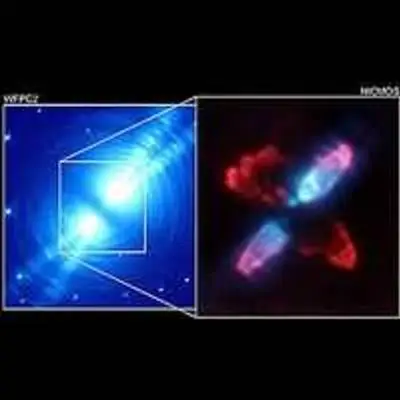
This composite image of the core of the galaxy was constructed by combining a visible light image taken with Hubble's Wide Field Planetary Camera 2 (WFPC2), with a separate image taken in ultraviolet light with the Faint Object Camera (FOC). While the visible light image shows a dark dust disk, the ultraviolet image (color-coded blue) shows a bright feature along one side of the disk. Because Hubble sees ultraviolet light reflected from only one side of the disk, astronomers conclude the disk must be warped like the brim of a hat. The bright white spot at the image's center is light from the vicinity of the black hole which is illuminating the disk.
[Left]
A ground-based telescopic view of the core of the elliptical galaxy NGC 6251. The inset box shows Hubble Space Telescope's field of view. The galaxy is 300 million light-years away in the constellation Ursa Minor.
Credits
Philippe Crane (European Southern Observatory) and NASAImage Details
| About The Object | |
|---|---|
| Object Name | NGC 6251 |
| R.A. Position | 16h 32m 31.63s |
| Dec. Position | 82° 32' 16.29" |
Downloads
Source
Image and source material are credited to the official mission archive linked below.
View on NASA.gov