Hubble image archive
A Grand View of the Birth of "Hefty" Stars – 30 Doradus Nebula Montage
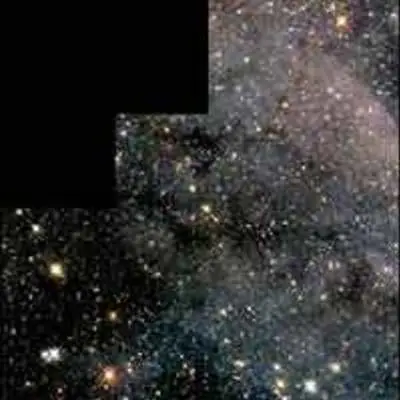
This picture, taken in visible light with the Hubble Space Telescope's Wide Field and Planetary Camera 2 (WFPC2), represents a sweeping view of the 30 Doradus Nebula. But Hubble's infrared camera - the Near Infrared Camera and Multi-Object Spectrometer (NICMOS) - has probed deepe...
- Date
- Jan 1, 1999
- Mission
- Hubble Space Telescope
- Archive ID
- hubblesite-images-1999-33-883-image

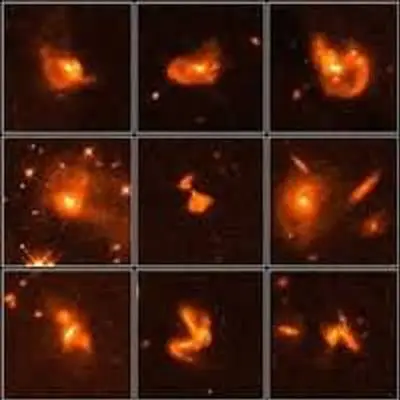
This picture, taken in visible light with the Hubble Space Telescope's Wide Field and Planetary Camera 2 (WFPC2), represents a sweeping view of the 30 Doradus Nebula. But Hubble's infrared camera - the Near Infrared Camera and Multi-Object Spectrometer (NICMOS) - has probed deeper into smaller regions of this nebula to unveil the stormy birth of massive stars. The montages of images in the upper left and upper right represent this deeper view. Each square in the montages is 15.5 light-years (19 arcseconds) across.
The brilliant cluster R136, containing dozens of very massive stars, is at the center of this image. The infrared and visible-light views reveal several dust pillars that point toward R136, some with bright stars at their tips. One of them, at left in the visible-light image, resembles a fist with an extended index finger pointing directly at R136. The energetic radiation and high-speed material emitted by the massive stars in R136 are responsible for shaping the pillars and causing the heads of some of them to collapse, forming new stars. The infrared montage at upper left is enlarged in an accompanying image.
Credits
NICMOS montages: NASA/Nolan Walborn (Space Telescope Science Institute, Baltimore, Md.) and Rodolfo Barba' (La Plata Observatory, La Plata, Argentina);WFPC2 image: NASA/John Trauger (Jet Propulsion Laboratory, Pasadena, Calif.) and James Westphal (California Institute of Technology, Pasadena, Calif.)
Image Details
| About The Object | |
|---|---|
| Object Name | 30 Doradus, R136 |
| R.A. Position | 05h 38m 42.39s |
| Dec. Position | -69° 6' 2.81" |
Downloads
Source
Image and source material are credited to the official mission archive linked below.
View on NASA.gov