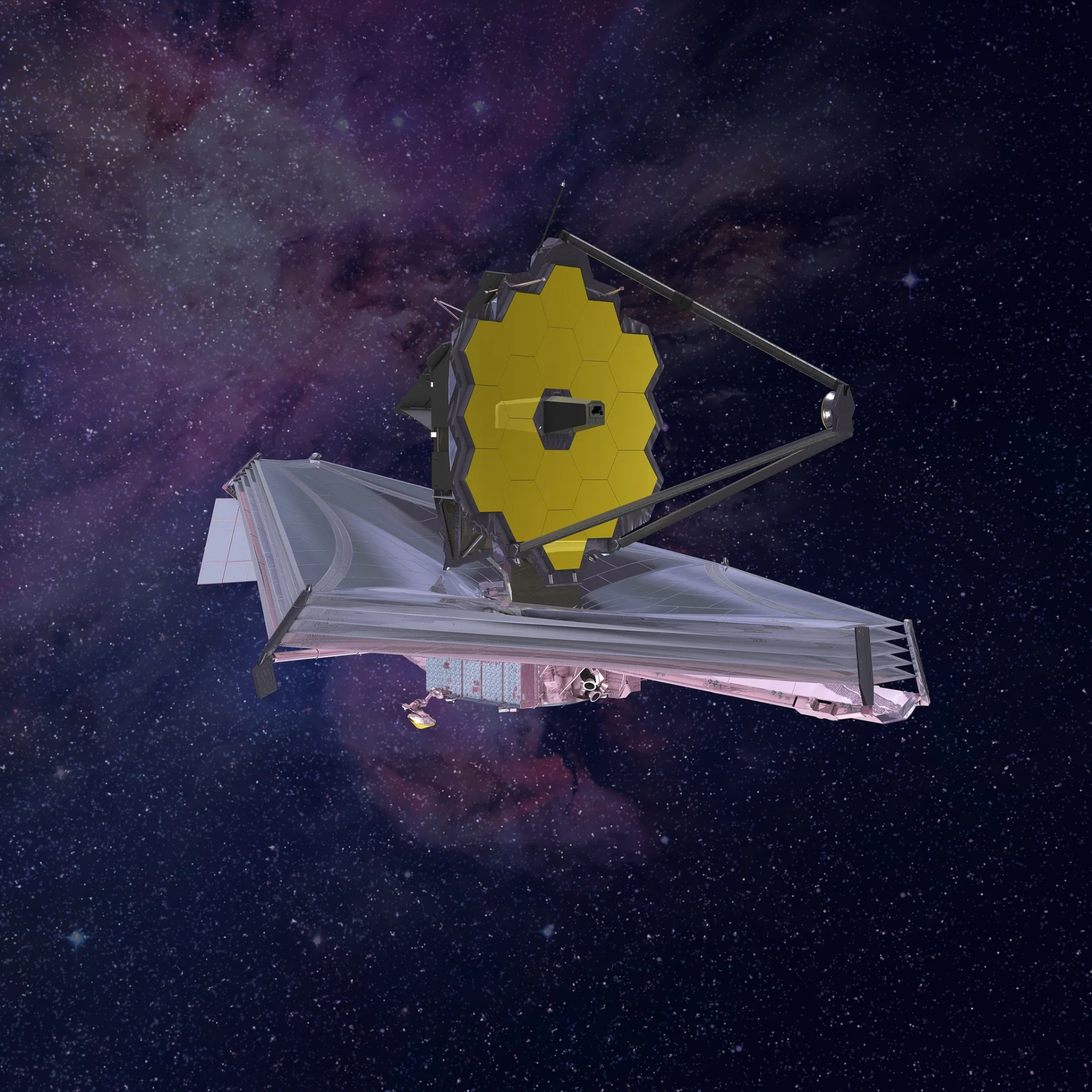
James Webb Space Telescope
The infrared eye on the first light.
Webb looks through cosmic dust and across more than 13 billion years of history to reveal how galaxies, stars, planets, and possible habitats take shape.
Observatory artwork: NASA · Official Webb mission ↗
- Launched
- December 25, 2021
- Vantage point
- 1.5 million km from Earth
- Primary mirror
- 6.5 m · 18 segments
- Wavelengths
- 0.6–28.5 microns
Why Webb exists
A cold observatory built for ancient light.
Webb combines a segmented gold-coated mirror, a five-layer sunshield, and instruments cooled for infrared astronomy. From L2, it keeps the Sun, Earth, and Moon on the same side of its shield while the observatory faces deep space.
That architecture lets Webb detect faint heat signatures and redshifted light that visible-light observatories cannot see alone.
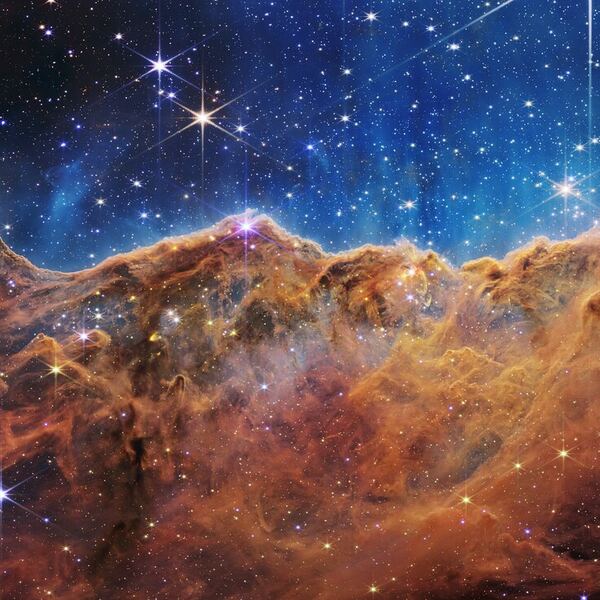
Latest mission imagery
The universe through Webb.
Explore the newest public Webb images, from nearby planetary systems to galaxies whose light began its journey billions of years ago.


Science across cosmic time
From the first galaxies to nearby worlds.
Webb is a general-purpose observatory. Its programs connect the earliest eras of the universe with the planetary systems forming around stars today.
First light
Find and characterize early galaxies whose light has stretched into infrared wavelengths during its journey across the expanding universe.
Stars taking shape
See through dusty stellar nurseries to study newborn stars, planet-forming disks, and the chemistry that seeds new systems.
Other worlds
Measure exoplanet atmospheres, temperatures, clouds, and molecules while also observing planets, moons, and small bodies closer to home.
The science payload
Four instruments. One exceptionally cold view.
Webb turns infrared light into images and spectra with complementary instruments mounted behind its primary mirror.
NIRCam
Near-Infrared Camera
Webb’s primary near-infrared imager also helps align the 18 mirror segments.
NIRSpec
Near-Infrared Spectrograph
Can collect spectra for many targets at once to reveal distance, motion, temperature, and chemistry.
MIRI
Mid-Infrared Instrument
Extends Webb into longer wavelengths for cooler objects, warm dust, and deeply embedded star formation.
FGS/NIRISS
Fine guidance and precision spectroscopy
Keeps Webb locked on target and supports specialized imaging and exoplanet observations.
Mission arc
Engineered over decades. Unfolded in weeks.
-
A next-generation space telescope takes shape
Early studies establish the goal of a large, cold infrared observatory able to look beyond Hubble’s wavelength range.
-
Launch and deployment
Webb launches aboard Ariane 5, then completes a complex sequence to unfold its sunshield and segmented mirror.
-
The first full-color science images
The first public observations demonstrate Webb’s sensitivity to galaxies, stellar nurseries, exoplanet atmospheres, and cosmic structure.
-
A working observatory at L2
International observing programs use Webb across astrophysics and planetary science while its archive continues to grow.
The archive is the mission
See what Webb is returning now.
Browse the newest public images, revisit landmark observations, or open the live tracker to follow Webb around Sun–Earth L2.