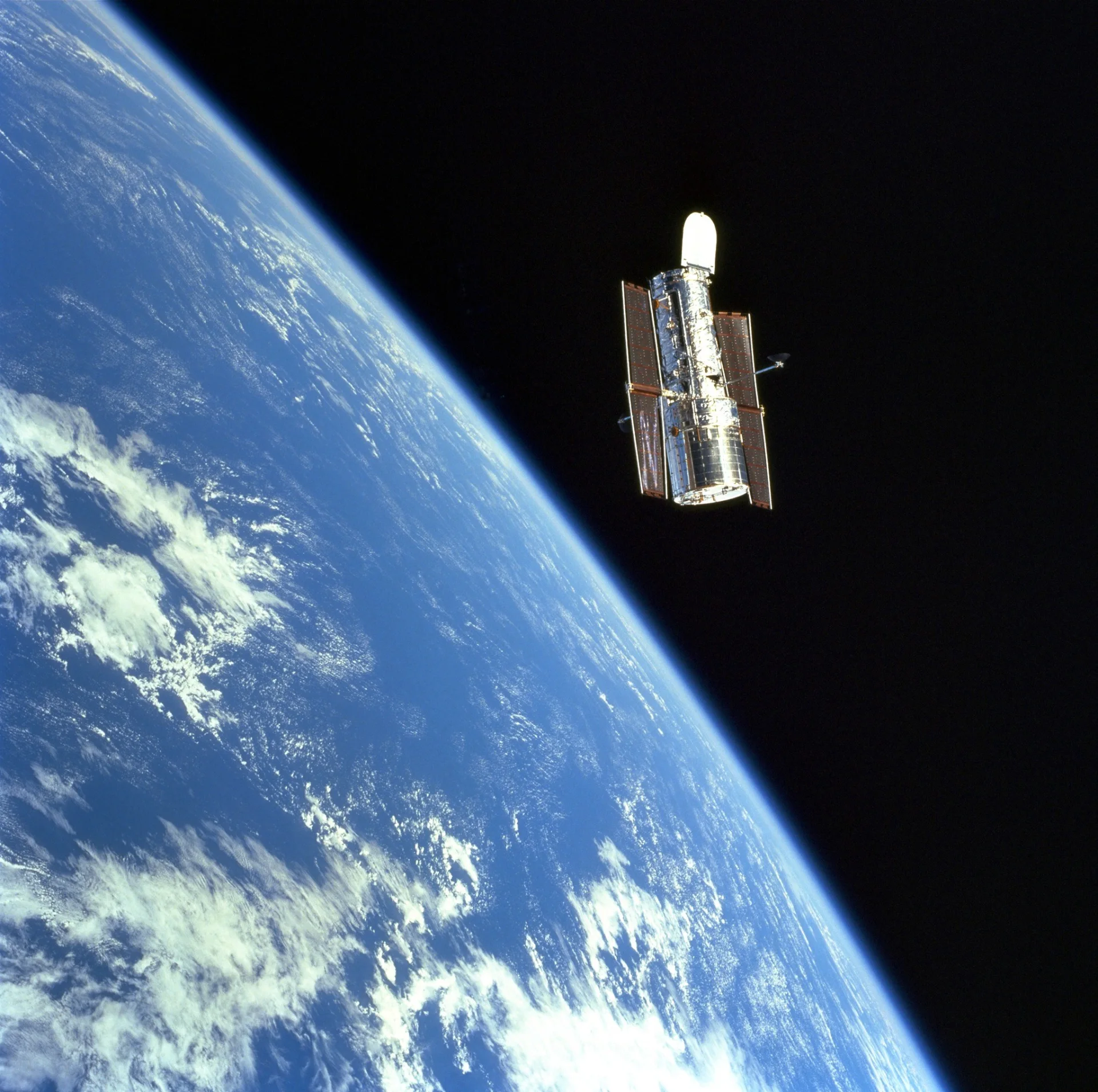
Hubble Space Telescope
The telescope that changed how we see the universe.
For more than three decades, Hubble has turned a clear view above Earth’s atmosphere into measurements and images that reshaped nearly every field of astronomy.
Orbital photograph: NASA · Official Hubble mission ↗
- Launched
- April 24, 1990
- Orbit
- Earth every ~95 minutes
- Primary mirror
- 2.4 meters
- Human upgrades
- 5 servicing missions
A repairable observatory
Built to evolve while already in space.
Hubble was designed so astronauts could replace instruments, repair systems, and expand its capabilities in orbit. Five servicing missions transformed the telescope from a pioneering observatory into a continually renewed scientific platform.
Its position above the atmosphere gives Hubble stable, sharp access to ultraviolet, visible, and near-infrared light, complementing Webb’s colder infrared view.
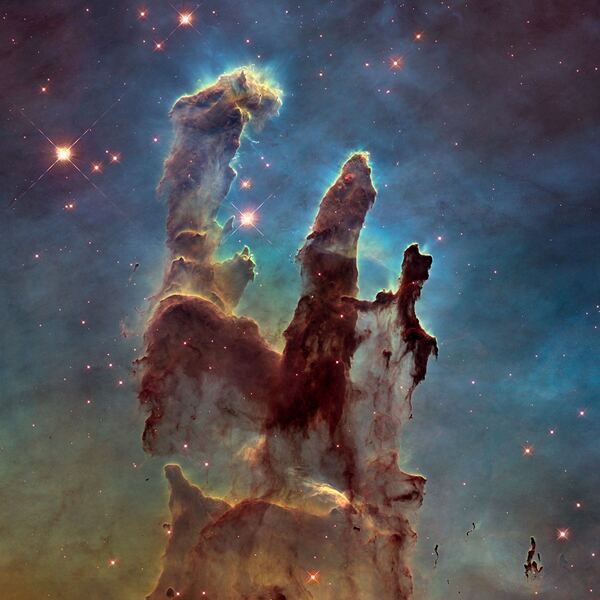
Latest mission imagery
Three decades of discovery, still growing.
Browse recent Hubble releases and revisit the observations that turned distant galaxies, nebulae, and planets into shared visual history.


A transformed universe
Precision that became cultural memory.
Hubble pairs rigorous measurement with extraordinary imagery. Its long baseline lets astronomers see change, revisit discoveries, and compare the universe across generations.
Cosmic expansion
Refine the expansion rate of the universe, observe distant supernovae, and help reveal that cosmic expansion is accelerating.
Deep time
Use deep-field observations to turn apparently empty patches of sky into histories containing thousands of distant galaxies.
Living systems
Track stars, nebulae, galaxies, planets, and changing atmospheres with a consistent observatory record spanning decades.
The working observatory
A toolbox renewed in orbit.
Hubble’s current instrument suite combines wide-field imaging with ultraviolet and optical spectroscopy.
WFC3
Wide Field Camera 3
Captures high-resolution ultraviolet, visible, and near-infrared images across a broad range of targets.
COS
Cosmic Origins Spectrograph
Uses ultraviolet spectroscopy to study the large-scale structure and chemical evolution of the universe.
ACS
Advanced Camera for Surveys
Delivers wide-field, high-sensitivity imaging used for galaxies, dark matter, and distant-universe surveys.
STIS
Space Telescope Imaging Spectrograph
Combines imaging and spectroscopy to separate light by wavelength and reveal physical conditions in cosmic objects.
Mission arc
Launched once. Reinvented five times.
-
Hubble reaches orbit
Space Shuttle Discovery deploys the observatory, opening a long-duration platform above Earth’s atmosphere.
-
Astronauts restore sharp vision
The first servicing mission installs corrective optics and a new camera, solving the primary mirror’s optical error.
-
Four more servicing missions
Astronaut crews replace instruments, computers, gyroscopes, batteries, insulation, and other critical systems.
-
An active scientific partnership
Hubble continues observing while its decades-long archive gains new value alongside Webb and other observatories.
A living record
Decades of discovery, one image archive.
Explore Hubble’s newest public releases and the iconic observations that made the universe feel both larger and more familiar.