Introduction to NGC 7129
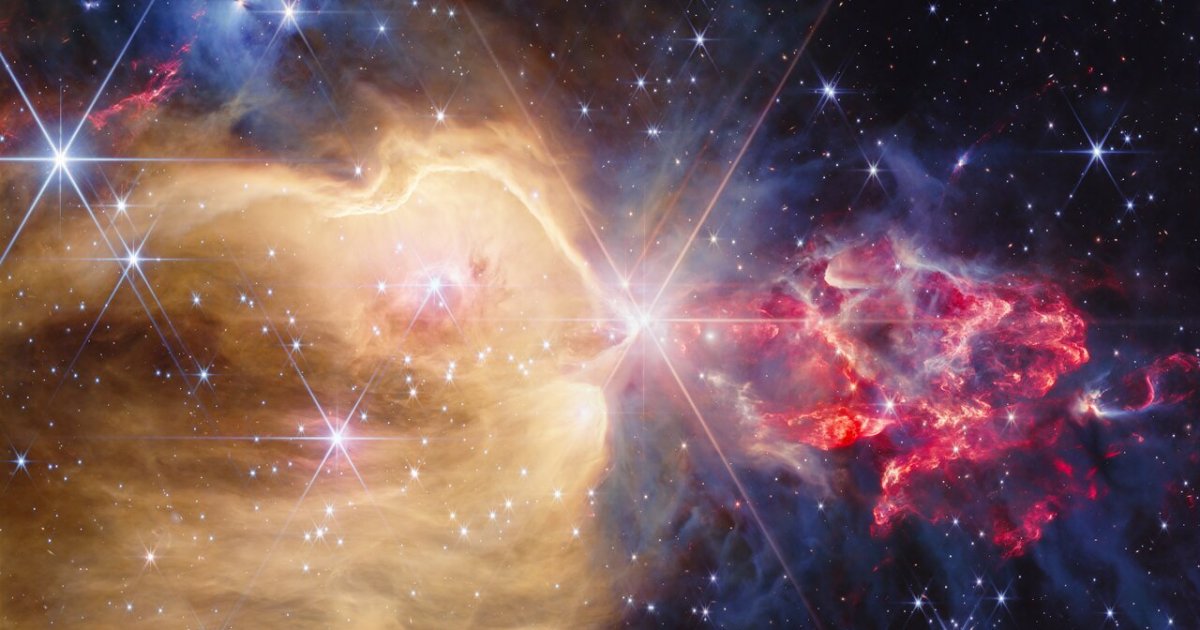
The James Webb Space Telescope (JWST) has once again demonstrated its unparalleled ability to unveil the mysteries of the universe by capturing a new image of NGC 7129, a stellar nursery located approximately 3,300 light-years away in the constellation Cepheus. This remarkable image, taken by the Near Infrared Camera (NIRCam), provides an unprecedented view of the complex processes involved in star formation.
The 3.5-Light-Year Cavity
At the heart of NGC 7129 lies a 3.5-light-year-wide cavity, carved out by the powerful outflows from the pre-main-sequence star LkHa 234. With a mass estimated between 5 to 8 times that of our Sun, LkHa 234 is a significant force in this region. The outflows from this young star have cleared away surrounding material, creating a vast space that allows astronomers to observe the intricate interactions at play in this stellar nursery.
Bow Shocks and Embedded Young Stars
The image also reveals dramatic bow shocks, which are arc-shaped structures formed when the stellar winds from young stars collide with the surrounding interstellar medium. These bow shocks are indicative of the intense activity within NGC 7129, as embedded young stars continue to shape their environment through energetic outflows.
Photodissociation Ridge
One of the most striking features captured by Webb's NIRCam is the photodissociation ridge, where molecular hydrogen is torn apart by the intense radiation from nearby stars. This ridge highlights the delicate balance between the formation and destruction of molecular clouds, a crucial aspect of star formation.
Hidden Protostars and Shocked Outflows
Within NGC 7129, hidden protostars drive shocked outflows that further contribute to the dynamic environment. These protostars, still in the early stages of their development, are surrounded by dense envelopes of gas and dust that obscure them from direct view. However, the effects of their outflows are visible as they interact with the surrounding material, creating shock waves that ripple through the nebula.
The Bat Shadow Silhouette
Among the fascinating features in NGC 7129 is a protostar whose donut-shaped disk casts a silhouette reminiscent of a Bat Shadow. This phenomenon occurs when the light from the protostar is blocked by its circumstellar disk, creating a shadow that stretches across the nebula. Such features provide valuable insights into the early stages of star formation and the role of circumstellar disks in the evolution of young stars.
For more detailed insights, you can explore the ESA's detailed release and NASA's coverage of the Webb's observations.