Introduction to Primordial Gravitational Waves
The quest to detect primordial gravitational waves is a frontier in cosmology, offering insights into the early universe and the theory of cosmic inflation. These waves are ripples in spacetime, predicted to have been generated during the inflationary epoch, a fraction of a second after the Big Bang. Detecting them would provide strong evidence for inflation and help refine our understanding of the universe's birth.
The Role of the Cosmic Microwave Background
The cosmic microwave background (CMB) is the afterglow of the Big Bang, permeating the universe. It is a crucial tool for cosmologists as it carries information about the early universe. One of the most promising methods to detect primordial gravitational waves is through the B-mode polarization of the CMB. This polarization pattern is a signature of gravitational waves and is incredibly faint, requiring highly sensitive instruments to detect.
SPT-3G Camera and BICEP Array
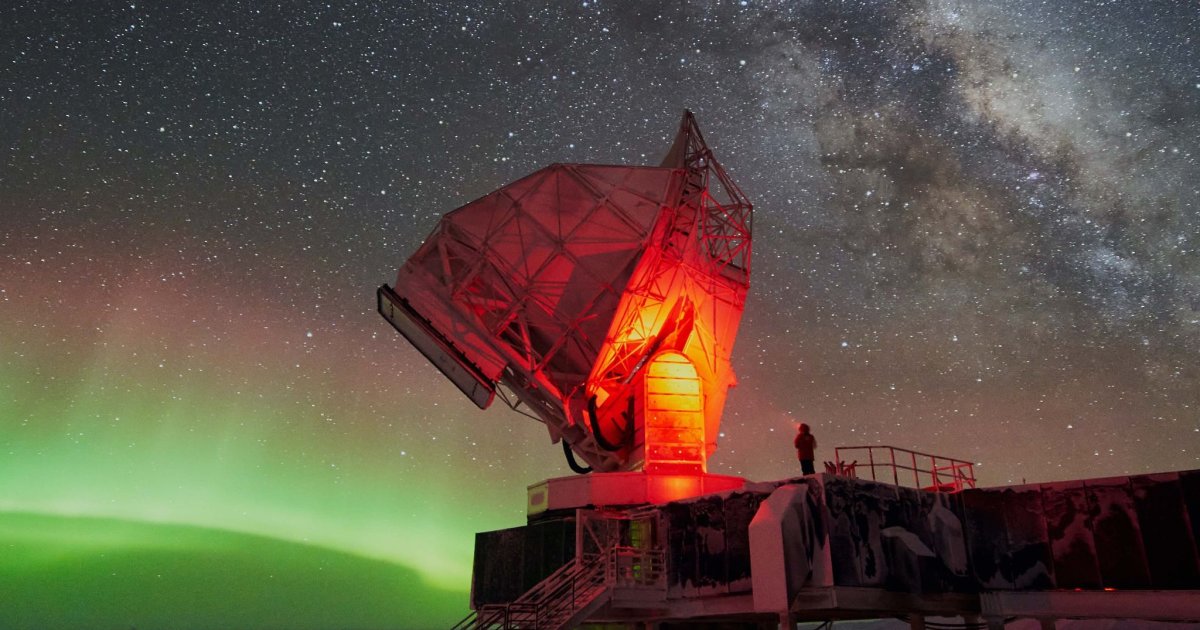
The South Pole Telescope (SPT) and its SPT-3G camera, along with the BICEP Array, are at the forefront of this hunt. Located at the South Pole, these instruments benefit from the cold, dry, and stable atmosphere, which is ideal for observing the CMB. The SPT-3G camera is designed to detect the faint nanokelvin B-mode polarization patterns in the CMB, which are indicative of primordial gravitational waves. The BICEP Array complements this by focusing on the same polarization signals, enhancing the sensitivity and accuracy of the observations.
Delensing: Sharpening the Signal
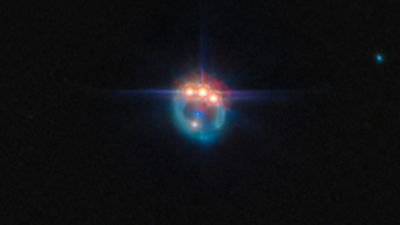
A significant challenge in detecting B-mode polarization is the contamination from gravitational lensing. This effect, caused by massive structures bending the path of CMB photons, can mimic the B-mode signal. To address this, scientists employ a technique called delensing, which involves using additional data to remove the lensing effect from the CMB maps. The SPT-3G camera has made strides in this area by producing new lensing maps that improve the accuracy of delensing. By combining these maps with data from the Planck satellite, scientists can better isolate the primordial B-mode signal. This process sharpens the limit on the tensor-to-scalar ratio (r), a crucial parameter that quantifies the strength of gravitational waves relative to density fluctuations in the early universe.
Testing Cosmic Inflation
The tensor-to-scalar ratio is a critical test for theories of cosmic inflation. A detection of a non-zero value of r would provide strong evidence for inflationary models that predict the existence of primordial gravitational waves. Current observations have placed stringent upper limits on r, but the improved delensing techniques and enhanced sensitivity of the SPT-3G and BICEP Array are pushing these limits further. Scientists estimate that ongoing and future observations could either detect a primordial B-mode signal or reduce the upper limit on r to unprecedented levels. This would significantly constrain or support various inflationary models, refining our understanding of the universe's earliest moments.
Conclusion
The hunt for primordial gravitational waves through the CMB's B-mode polarization is a challenging but promising endeavor. The SPT-3G camera and BICEP Array, with their advanced delensing techniques, are at the cutting edge of this research. As these instruments continue to refine their observations, they bring us closer to understanding the universe's origins and the fundamental physics that shaped it. For more detailed insights, you can explore the Department of Energy's article and the arXiv preprint on this topic.