Introduction to Hubble's Gravitational Lens Collage
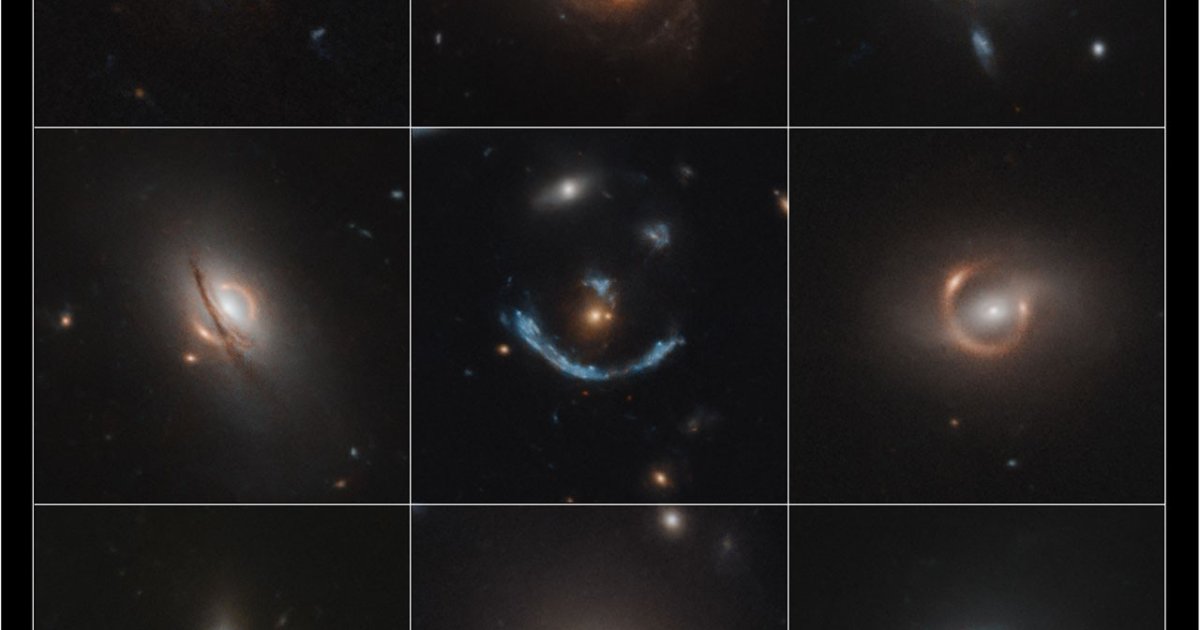
On November 12, 2026, NASA released an intriguing nine-panel collage of strong gravitational lenses captured by the Hubble Space Telescope. These cosmic phenomena were initially detected by the Dark Energy Spectroscopic Instrument (DESI) at Kitt Peak National Observatory. This collection serves as a preparatory tool for the Nancy Grace Roman Space Telescope, launched in August 2026, which aims to delve deeper into the mysteries of dark matter substructures.
Understanding Gravitational Lensing
Gravitational lensing occurs when a massive object, like a galaxy cluster, bends the light from a more distant object, such as a galaxy or quasar, causing it to appear distorted or magnified. This effect is a powerful tool for astronomers, allowing them to study the distribution of dark matter, which does not emit, absorb, or reflect light, making it invisible and detectable only through its gravitational effects.
The Role of DESI in Identifying Lenses
DESI, operational since 2019, has been instrumental in mapping the universe's large-scale structure and identifying strong gravitational lenses. These lenses are critical for understanding the distribution and behavior of dark matter. The data provided by DESI has enabled Hubble to capture detailed images of these lenses, showcasing the intricate patterns of light distortion.
Hubble's Contribution to Dark Matter Research
The nine-panel collage released by Hubble offers a diverse range of gravitational lenses, each serving as a unique cosmic laboratory. These images provide a glimpse into the universe's structure and the role dark matter plays in shaping it. By studying these lenses, scientists can test the cold dark matter model, which predicts that dark matter consists of slow-moving particles that clump together to form structures ranging from a million to a billion solar masses.
Preparing the Roman Space Telescope
The Nancy Grace Roman Space Telescope is set to take this research further. Equipped with advanced instruments, it will hunt for dark matter clumps by analyzing tiny distortions in the lensed arcs captured by Hubble. This mission aims to refine our understanding of dark matter's distribution and properties, potentially challenging or confirming existing cosmological models.
The Significance of Dark Matter Substructures
Dark matter substructures are smaller clumps of dark matter that influence the formation and evolution of galaxies. Understanding these substructures is crucial for testing the cold dark matter hypothesis. By examining the subtle distortions in gravitational lenses, the Roman Space Telescope will provide unprecedented insights into these elusive components of the universe.
Future Implications for Cosmology
The collaboration between Hubble and the Roman Space Telescope represents a significant leap in cosmological research. By combining Hubble's detailed imaging with Roman's wide-field survey capabilities, scientists aim to achieve a more comprehensive understanding of dark matter and its role in the universe. This research could lead to breakthroughs in our understanding of fundamental physics and the nature of the universe.
For more information, you can explore NASA's official page on the Hubble release and the Roman Space Telescope's mission details.