Introduction to Messier 82: The Cigar Galaxy
Messier 82, commonly known as the Cigar Galaxy, has long intrigued astronomers with its intense starburst activity. Located about 12 million light-years away in the constellation Ursa Major, M82 forms stars at a rate ten times faster than our own Milky Way. This rapid star formation is driven by a complex interplay of gravitational interactions and internal dynamics, which the James Webb Space Telescope (JWST) has now captured in unprecedented detail. A new 3D visualization released by NASA and the Space Telescope Science Institute (STScI) on August 26, 2026, sheds light on the galaxy's star-forming mechanisms and its dramatic superwind outflows.
The Power of Webb's NIRCam Survey
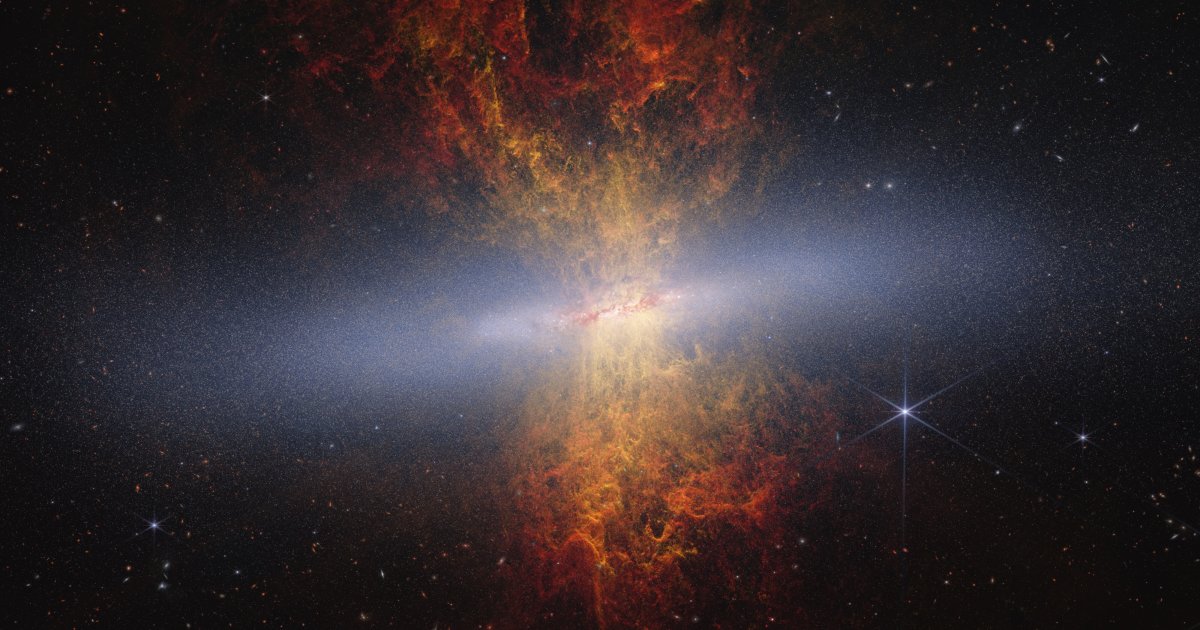
The JWST's Near-Infrared Camera (NIRCam) conducted a comprehensive 65-hour survey of M82, resolving an astounding 16.5 million stars through the galaxy's dense dust clouds. This detailed observation was made possible by the NIRCam's ability to penetrate dust and capture infrared light, offering a clearer view of the galaxy's core regions. The survey not only mapped the distribution of stars but also revealed the intricate structure of M82's hourglass-shaped starburst superwind, composed of ionized gas and polycyclic aromatic hydrocarbon (PAH) dust grains.
Why M82 Forms Stars at a Breakneck Pace
Messier 82's rapid star formation is primarily driven by its gravitational interactions with its neighboring galaxy, Messier 81. These interactions compress gas clouds within M82, triggering a starburst phase that fuels the creation of new stars. Scientists estimate that the galaxy's star formation rate is about ten times greater than that of the Milky Way, a phenomenon that has persisted for millions of years. The intense gravitational forces at play cause gas and dust to collapse more efficiently, leading to the birth of massive, short-lived stars that further energize the surrounding environment.
The Superwind: A Galactic Outflow of Energy
The superwind phenomenon in M82 is a direct consequence of its vigorous star formation. As massive stars reach the end of their life cycles, they explode as supernovae, releasing tremendous amounts of energy. This energy drives a powerful outflow of ionized gas and dust, forming a spectacular hourglass-shaped structure extending thousands of light-years into space. The superwind carries away material from the galaxy, influencing its future star formation potential and contributing to the enrichment of the intergalactic medium.
Implications for Galaxy Evolution
The insights gained from Webb's 3D visualization of M82 have significant implications for our understanding of galaxy evolution. The superwind not only regulates star formation within the galaxy but also plays a crucial role in the cosmic cycle of matter. By expelling gas and dust, the superwind can suppress further star formation, potentially leading to a quiescent phase in the galaxy's evolution. Furthermore, the material expelled into the intergalactic medium can seed future star formation in other regions of the universe.
This new understanding of M82's dynamics highlights the importance of starburst galaxies in the broader context of cosmic evolution. By studying these intense star-forming regions, astronomers can gain insights into the processes that shaped the early universe, providing a window into the past and future of galaxy formation.
Conclusion
The James Webb Space Telescope's 3D visualization of Messier 82 offers a remarkable glimpse into the inner workings of a starburst galaxy. By resolving millions of stars and mapping the galaxy's superwind, Webb has provided valuable data that enhances our understanding of star formation and galactic evolution. As scientists continue to analyze these findings, we can expect further revelations about the complex processes that govern our universe.
For more detailed information, you can explore the official releases from NASA and the European Space Agency.