Introduction to Early Data Preview 2
The Vera C. Rubin Observatory, a groundbreaking astronomical facility, has recently released its Early Data Preview 2 (EDP2), offering a glimpse into the universe's hidden structures. This preview is part of the Legacy Survey of Space and Time (LSST), which aims to map the sky in unprecedented detail. EDP2 has already yielded exciting discoveries, including two new companions of the Milky Way: Aquarius IV and Rubin-GC1.
Aquarius IV: An Ultra-Faint Dwarf Satellite
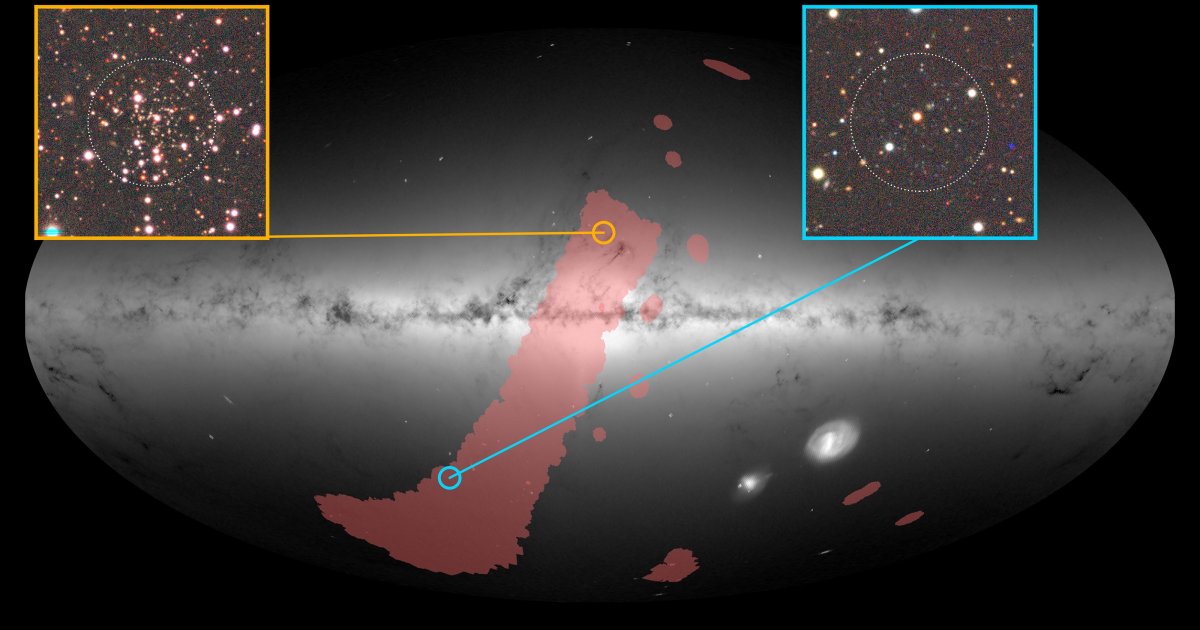
Aquarius IV (Rubin J2201-0234) is an ultra-faint dwarf satellite located approximately 355,000 light-years away in the outer halo of the Milky Way. These types of galaxies are among the smallest and least luminous, making them challenging to detect. However, they are significant in the study of dark matter, as they contain a high ratio of dark matter to visible matter. Scientists estimate that ultra-faint dwarfs like Aquarius IV are excellent laboratories for probing the nature of dark matter, providing insights into its distribution and properties.
Dark matter is a mysterious substance that does not emit, absorb, or reflect light, making it invisible and detectable only through its gravitational effects. The abundance of dark matter in ultra-faint dwarfs suggests that these galaxies are dominated by dark matter, offering a unique opportunity to study its role in galaxy formation and evolution.
Rubin-GC1: A Dust-Shrouded Globular Cluster
Rubin-GC1 (Rubin J1628-1735) is a newly discovered globular cluster located in the constellation Ophiuchus. It is approximately 9.2 billion years old and is associated with the Sagittarius stream, a tidal stream of stars that is a remnant of a dwarf galaxy being torn apart by the Milky Way's gravity. This discovery is significant because it provides further evidence of the complex interactions and mergers that have shaped our galaxy over billions of years.
Globular clusters like Rubin-GC1 are dense groups of stars that orbit the galactic core. They are crucial for understanding the formation and evolution of galaxies, as they are among the oldest structures in the universe. The discovery of Rubin-GC1 adds to the growing list of known globular clusters and helps astronomers piece together the history of the Milky Way's formation.
The LSST Census and Future Discoveries
The LSST, conducted by the Vera C. Rubin Observatory, is set to revolutionize our understanding of the universe. By surveying the entire southern sky repeatedly over a decade, the LSST will create a comprehensive map of the cosmos, capturing changes over time and revealing transient phenomena. This ambitious project is expected to discover thousands of new celestial objects, including asteroids, supernovae, and distant galaxies.
The discoveries of Aquarius IV and Rubin-GC1 are just the beginning. As the LSST continues, scientists anticipate uncovering many more ultra-faint dwarf galaxies and globular clusters, enhancing our understanding of dark matter and the Milky Way's history. The data collected will also help refine models of galaxy formation and evolution, providing a deeper understanding of the universe's structure and dynamics.
For more information on the Vera C. Rubin Observatory and its discoveries, visit the Yale News and arXiv pages.