Introduction to the Treble Clef Radio Source
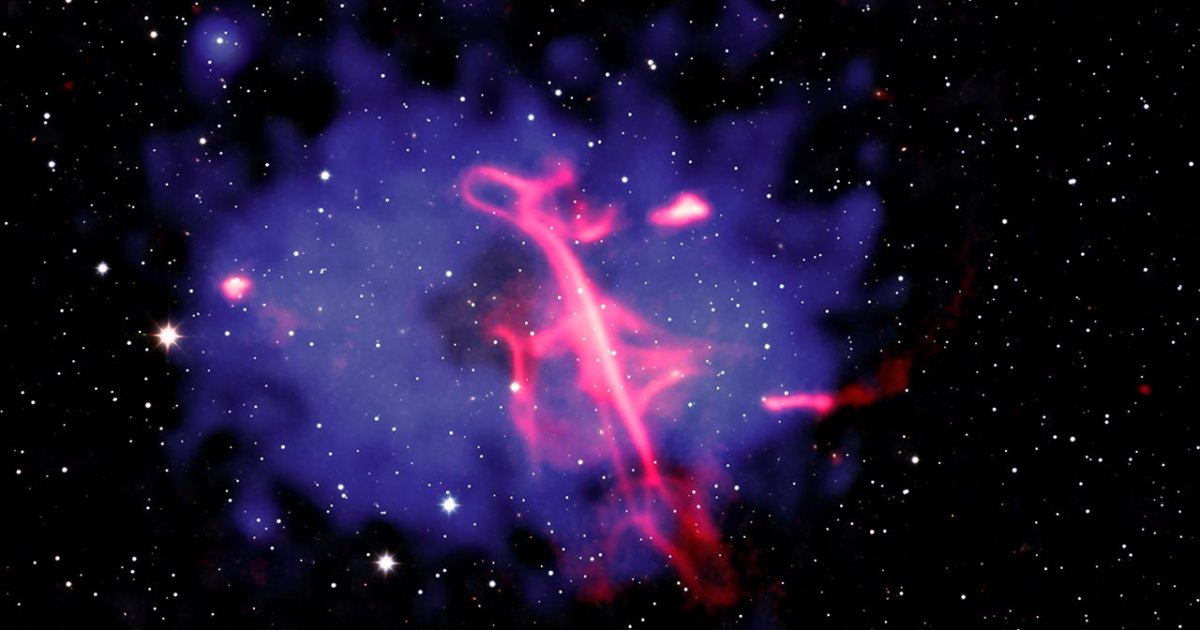
The universe is a vast orchestra, with celestial objects playing their unique parts in a cosmic symphony. One of the most intriguing players in this orchestra is the Treble Clef radio source, a mysterious entity recently illuminated by NASA's Chandra X-ray Observatory. Hidden behind the plane of the Milky Way, this enigmatic source resides within two colliding galaxy clusters, revealing a dramatic interplay between ancient black hole activity and the dynamic forces of cluster mergers.
Unraveling the Mystery: Chandra's Contribution
In October 2026, Chandra's observations provided a clearer view of the Treble Clef radio source, nestled within the heart of two colliding galaxy clusters. This discovery was significant because it shed light on a complex cosmic event that had been obscured by the dense star fields of our galaxy. The X-ray data from Chandra revealed that the Treble Clef is not just a simple radio source but a relic of an ancient supermassive black hole outburst, now re-energized by the merger of these massive clusters.
The Role of an Ancient Black Hole Outburst
Scientists estimate that hundreds of millions of years ago, a supermassive black hole at the center of one of these galaxy clusters experienced a powerful outburst. This event expelled vast amounts of energy into the surrounding space, creating a radio cloud that has persisted through the ages. Over time, this radio cloud began to fade, losing its energy and becoming less visible to astronomers.
Re-energization by Galaxy Cluster Merger
The collision of the two galaxy clusters, however, has breathed new life into this ancient structure. As these clusters merge, they generate shock waves and turbulence that can re-energize the particles within the fading radio cloud. This process, akin to striking a cosmic tuning fork, has revived the Treble Clef, allowing it to shine brightly once more in radio wavelengths.
Multi-Wavelength Evidence: A Symphony of Observations
While Chandra provided crucial X-ray data, the full picture of the Treble Clef radio source has been painted with observations across the electromagnetic spectrum. The eROSITA telescope, part of the Spectrum-Roentgen-Gamma mission, has contributed additional X-ray observations that complement Chandra's findings. These data help map the distribution of hot gas within the clusters, crucial for understanding the dynamics of the merger.
In the radio domain, the LOFAR (Low-Frequency Array) telescope has played a pivotal role. LOFAR's sensitivity to low-frequency radio waves has allowed astronomers to trace the intricate structures of the re-energized radio cloud, providing insights into the processes that have revived it. Meanwhile, the UKIRT (United Kingdom Infrared Telescope) has offered infrared observations that help identify the galaxies involved in the collision, offering clues about their past interactions and future fates.
Understanding Cluster-Merger Physics
The collision of galaxy clusters is one of the most energetic events in the universe, second only to the Big Bang. When clusters collide, they release enormous amounts of energy, heating the intracluster medium to extreme temperatures and creating shock waves that propagate through the gas. These shock waves can accelerate particles to near-light speeds, re-energizing old radio structures like the Treble Clef.
Furthermore, the turbulence generated by the merger can amplify magnetic fields, which in turn can influence the behavior of charged particles within the radio cloud. This complex interplay of forces makes cluster mergers a fascinating area of study, offering insights into both the large-scale structure of the universe and the microphysics of particle acceleration.
Conclusion: A Cosmic Symphony Continues
The Treble Clef radio source is a testament to the dynamic and interconnected nature of the cosmos. Through the combined efforts of observatories like Chandra, eROSITA, LOFAR, and UKIRT, astronomers are piecing together the story of an ancient black hole outburst and its revival through a galaxy cluster collision. As we continue to explore the universe, each new discovery adds another note to the cosmic symphony, enriching our understanding of the universe's grand composition.