Archivo de imágenes de Hubble
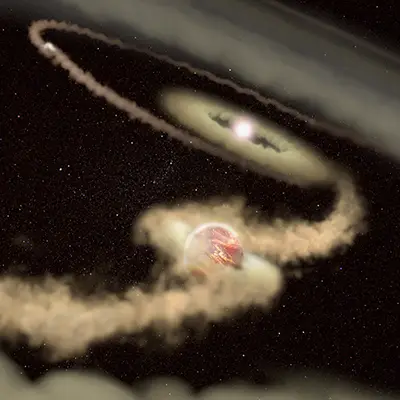
Ilustración del sistema Kepler 51
This illustration depicts the Sun-like star Kepler 51, and three giant planets that NASA's Kepler space telescope discovered in 2012-2014. These planets are all roughly the size of Jupiter but a tiny fraction of its mass. This means the planets have an extraordinarily low density...
- Fecha
- Jan 1, 2019
- Misión
- Hubble Space Telescope
- ID de archivo
- hubblesite-images-2019-60-4597-image

This illustration depicts the Sun-like star Kepler 51, and three giant planets that NASA's Kepler space telescope discovered in 2012-2014. These planets are all roughly the size of Jupiter but a tiny fraction of its mass. This means the planets have an extraordinarily low density, more like that of Styrofoam rather than rock or water, based on new Hubble Space Telescope observations. The planets may have formed much farther from their star and migrated inward. Now their puffed-up hydrogen/helium atmospheres are bleeding off into space. Eventually, much smaller planets might be left behind. The background starfield is correctly plotted as it would look if we gazed back toward our Sun from Kepler 51's distance of approximately 2,600 light-years, along our galaxy's Orion spiral arm. However, the Sun is too faint to be seen in this simulated naked-eye view.
Credits
NASA, ESA, and L. Hustak, J. Olmsted, D. Player and F. Summers (STScI)Más imágenes de este periodo
Fuente
La imagen y el material de referencia se acreditan al archivo oficial de la misión enlazado a continuación.
Ver en NASA.gov