Archivo de imágenes de Hubble
NGC 4485
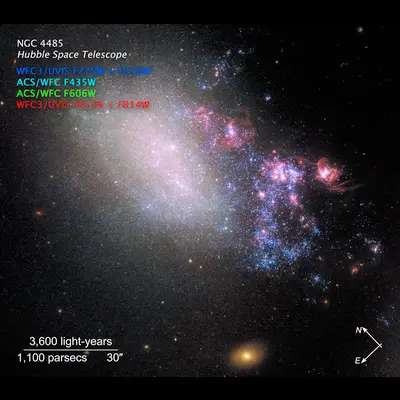
The irregular galaxy NGC 4485 shows all the signs of having been involved in a hit-and-run accident with a bypassing galaxy. Rather than destroying the galaxy, the chance encounter is spawning a new generation of stars, and presumably planets.The right side of the galaxy is ablaz...
- Fecha
- Jan 1, 2019
- Misión
- Hubble Space Telescope
- ID de archivo
- hubblesite-images-2019-30-4499-image

The irregular galaxy NGC 4485 shows all the signs of having been involved in a hit-and-run accident with a bypassing galaxy. Rather than destroying the galaxy, the chance encounter is spawning a new generation of stars, and presumably planets.
The right side of the galaxy is ablaze with star formation, shown in the plethora of young blue stars and star-incubating pinkish nebulas. The left side, however, looks intact. It contains hints of the galaxy's previous spiral structure, which, at one time, was undergoing normal galactic evolution.
The larger culprit galaxy, NGC 4490, is off the bottom of the frame. The two galaxies sideswiped each other millions of years ago and are now 24,000 light-years apart. The gravitational tug-of-war between them created rippling patches of higher-density gas and dust within both galaxies. This activity triggered a flurry of star formation.
This galaxy is a nearby example of the kind of cosmic bumper-car activity that was more common billions of years ago when the universe was smaller and galaxies were closer together.
NGC 4485 lies 25 million light-years away in the northern constellation Canes Venatici (the Hunting Dogs).
This new image, captured by Hubble's Wide Field Camera 3 (WFC3) and Advanced Camera for Surveys (ACS), provides further insight into the complexities of galaxy evolution.
Credits
NASA and ESA;Acknowledgment: T. Roberts (Durham University, UK), D. Calzetti (University of Massachusetts) and the LEGUS Team, R. Tully (University of Hawaii), and R. Chandar (University of Toledo)
Detalles de la imagen
| About The Object | |
|---|---|
| Object Name | NGC 4485 |
| Object Description | Interacting Galaxy |
| R.A. Position | 12:30:31.46 |
| Dec. Position | +41:41:43.40 |
| Constellation | Canes Venatici |
| Distance | 25 million light-years |
| Dimensions | Image is 2.12 arcmin across (about 15,400 light-years) |
| About The Data | |
| Data Description | The HST observations include those from programs (T. Roberts), (D. Calzetti), (R. Tully), (R. Chandar) |
| Instrument | WFC3/UVIS, ACS/WFC |
| Exposure Dates | 10 observations between November 2005 and January 2015 |
| Filters | WFC3/UVIS: F275W, F336W, F657N, F814W; ACS/WFC: F435W, F606W |
| About The Image | |
| Color Info | These images are a composite of separate exposures acquired by the WFC3/UVIS and ACS/WFC instruments on the Hubble Space Telescope. Several filters were used to sample narrow wavelength ranges. The color results from assigning different hues (colors) to each monochromatic (grayscale) image associated with an individual filter. In this case, the assigned colors are: Blue: F275W + F336W Cyan: F435W Green: F606W Red: F657N + F814W |
Más imágenes de este periodo
Descargas
Fuente
La imagen y el material de referencia se acreditan al archivo oficial de la misión enlazado a continuación.
Ver en NASA.gov