Archivo de imágenes de Hubble
Hubble revela posibles depósitos de óxido de titanio en Aristarchus y Schroter's Valley Rille
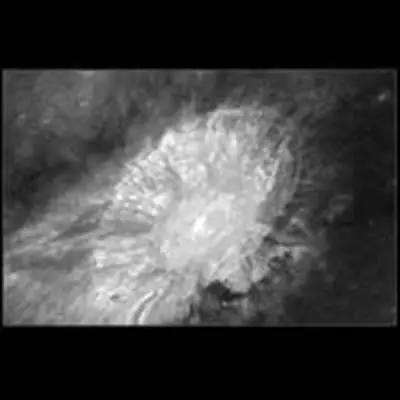
This view of the lunar impact crater Aristarchus and adjacent features (Herodotus crater, Schroter's Valley rille) illustrates the ultraviolet and visible wavelength characteristics of this geologically diverse region of the Moon. The two inset images illustrate one preliminary a...
- Fecha
- Jan 1, 2005
- Misión
- Hubble Space Telescope
- ID de archivo
- hubblesite-images-2005-29-1781-image

This view of the lunar impact crater Aristarchus and adjacent features (Herodotus crater, Schroter's Valley rille) illustrates the ultraviolet and visible wavelength characteristics of this geologically diverse region of the Moon. The two inset images illustrate one preliminary approach for isolating differences due to such effects as composition, soil maturity, mixing, and impact ejecta emplacement. The color composite in the lower right focuses on the 26-mile-diameter (42-kilometer-diameter) Aristarchus impact crater, and employs ultraviolet- to visible-color-ratio information to accentuate differences that are potentially diagnostic of ilmenite- (i.e, titanium oxide) bearing materials as well as pyroclastic glasses.
The same is the case for the image of a section of Schroter's Valley (rille) in the upper right. Bluer units in these spectral-ratio images suggest enrichment in opaque phases in a relative sense. The magenta color indicates dark mantle material which scientists believe contains titanium-bearing pyroclastic material.
The symphony of color within the Aristarchus crater clearly shows a diversity of materials - anorthosite, basalt, and olivine. The impact crater actually cut through a mare highlands boundary with superposed pyroclastics - a unique geologic setting on the Moon! The distinctive tongue of material extending out of the crater's southeastern rim is thought to be very olivine-rich material, based on Earth-based spectra and Clementine visible and infrared imaging data.
North is at the top in these images.
These images were acquired Aug. 21, 2005. The processing was accomplished by the Hubble Space Telescope Lunar Exploration Team at NASA's Goddard Space Flight Center, Northwestern University, and the Space Telescope Science Institute. False-color images were constructed using the red channel as 502/250 nanometers; the green as 502 nanometers; and the blue as 250/658 nanometers.
Credits
NASA, ESA and J. Garvin (NASA/GSFC)Detalles de la imagen
| About The Object | |
|---|---|
| Object Name | Moon |
| Object Description | Earth's Satellite |
| Distance | The Moon is 238,857 miles (384,403 kilometers) from the Earth. |
| Dimensions | The Moon has a diameter of 2160 miles (3476 kilometers). |
| About The Data | |
| Data Description | These HST data are from proposal . NASA's HST Lunar observation team is led by Chief Scientist J. Garvin. The team includes M. Robinson (Northwestern Univ.), D. Skillman (NASA/GSFC), B. Hapke (Univ. of Pittsburgh), C. Pieters (Brown Univ.), M. Ulmer (Northwestern Univ.), J. Bell (Cornell Univ.), and J. Taylor (Univ. of Hawaii). |
| Instrument | HST>ACS/HRC |
| Exposure Dates | August 21, 2005 |
| Filters | F250W (250nm), F344N (344nm), F502N (502nm), F658N (658nm) |
Descargas
Fuente
La imagen y el material de referencia se acreditan al archivo oficial de la misión enlazado a continuación.
Ver en NASA.gov