Archivo de imágenes de Hubble
Betelgeuse: efecto de la estela de la estrella compañera
Scientists used NASA’s Hubble Space Telescope to look for evidence of a wake being generated by a companion star orbiting the red supergiant Betelgeuse. They narrowed in on ultraviolet light emitted by ionized iron (Fe II, which is an iron atom that has lost one electron).Light f...
- Fecha
- Jan 5, 2026
- Misión
- Hubble Space Telescope
- ID de archivo
- betelgeuse-effect-of-companion-star-wake
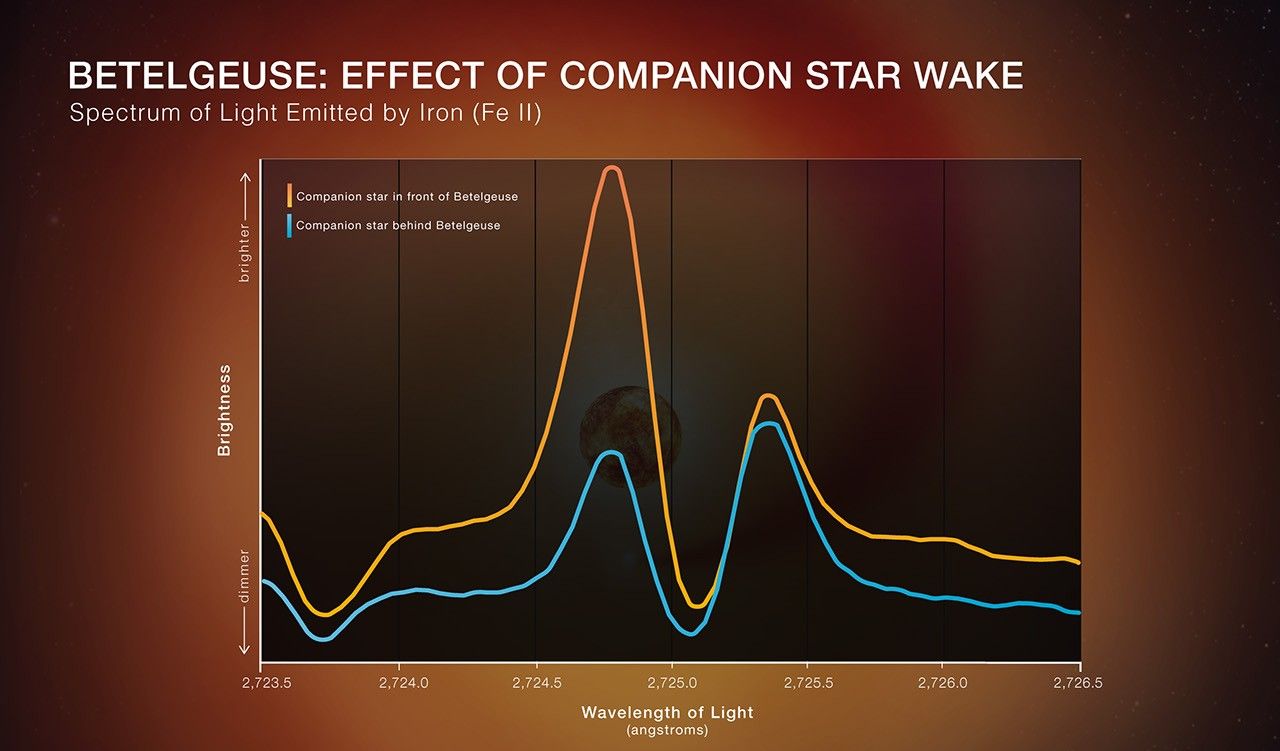
Scientists used NASA’s Hubble Space Telescope to look for evidence of a wake being generated by a companion star orbiting the red supergiant Betelgeuse. They narrowed in on ultraviolet light emitted by ionized iron (Fe II, which is an iron atom that has lost one electron).Light from material moving toward us is shifted toward shorter wavelengths, or blueshifted. The team found a noticeable difference in blueshifted light, shown in the lefthand peak on the spectrum graph, when the companion star was at different points in its orbit. Specifically, they saw significantly more blueshifted light when the companion star is in front of Betelgeuse, versus when the companion is behind Betelgeuse.This demonstrates that the supergiant’s atmosphere moves outward and absorbs the wake after the companion goes by, as would be expected by a wake. In other words, when the companion is in front, there is no wake to absorb the iron emission, so astronomers detect a strong peak, but after the companion passes in front of Betelgeuse, the wake that follows it absorbs the light from iron emission, leading to a shorter peak.Light from material moving toward us is shifted toward shorter wavelengths, or blueshifted. The team found a noticeable difference in blueshifted light, shown in the lefthand peak on the spectrum graph, when the companion star was at different points in its orbit. Specifically, they saw significantly more blueshifted light when the companion star is in front of Betelgeuse, versus when the companion is behind Betelgeuse.This demonstrates that the supergiant’s atmosphere moves outward and absorbs the wake after the companion goes by, as would be expected by a wake. In other words, when the companion is in front, there is no wake to absorb the iron emission, so astronomers detect a strong peak, but after the companion passes in front of Betelgeuse, the wake that follows it absorbs the light from iron emission, leading to a shorter peak.
Image Description: A graphic titled “Betelgeuse: Effect of Companion Star Wake” with a subtitle “Spectrum of Light Emitted by Iron (Fe II).” A graph plots brightness versus wavelength of light. The Y axis is labeled Brightness with an up arrow labeled brighter and a down arrow labeled dimmer. The X axis is labeled Wavelength of Light, angstroms with tick marks every 0.5 angstroms from 2723.5 at left to 2726.5 at right. The plot shows two wavy lines, an orange one on top and a blue one below it. The graph shows two distinct peaks. At left, or shorter wavelengths, the orange peak is much higher than the blue one. At right, or longer wavelengths, the two peaks are nearly the same height. A key shows that the orange line represents the companion star in front of Betelgeuse, while the blue line represents the companion star behind Betelgeuse.
Image Description: A graphic titled “Betelgeuse: Effect of Companion Star Wake” with a subtitle “Spectrum of Light Emitted by Iron (Fe II).” A graph plots brightness versus wavelength of light. The Y axis is labeled Brightness with an up arrow labeled brighter and a down arrow labeled dimmer. The X axis is labeled Wavelength of Light, angstroms with tick marks every 0.5 angstroms from 2723.5 at left to 2726.5 at right. The plot shows two wavy lines, an orange one on top and a blue one below it. The graph shows two distinct peaks. At left, or shorter wavelengths, the orange peak is much higher than the blue one. At right, or longer wavelengths, the two peaks are nearly the same height. A key shows that the orange line represents the companion star in front of Betelgeuse, while the blue line represents the companion star behind Betelgeuse.
Detalles de la imagen
| Release Date | January 5, 2026 |
| Science Release | NASA Hubble Helps Detect ‘Wake’ of Betelgeuse’s Elusive Companion Star |
| Credit | Illustration: NASA, ESA, Elizabeth Wheatley (STScI); Science: Andrea Dupree (CfA) |
| Last UpdatedLocationContact | Jan 05, 2026NASA Goddard Space Flight CenterMediaClaire Andreoli NASA’s Goddard Space Flight Center Greenbelt, Maryland [email protected] |
| Last Updated | Jan 05, 2026 |
| Location | NASA Goddard Space Flight Center |
| Contact | MediaClaire Andreoli NASA’s Goddard Space Flight Center Greenbelt, Maryland [email protected] |
| Related Terms | Hubble Space Telescope, Binary Stars, Stars |
Descargas
Fuente
La imagen y el material de referencia se acreditan al archivo oficial de la misión enlazado a continuación.
Ver en NASA.gov