Archivo de imágenes de Hubble
Estrella variable cefeida V1 en la galaxia de Andrómeda
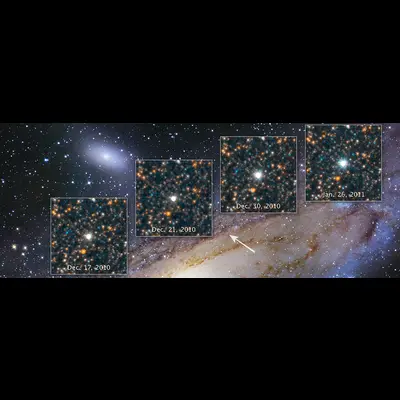
Caption In commemoration of Edwin Hubble's discovery of a Cepheid variable class star, called V1, in the neighboring Andromeda galaxy 100 years ago, astronomers partnered with the American Association of Variable Star Observers (AAVSO) to study the star. AAVSO observers followed...
- Fecha
- Jan 15, 2025
- Misión
- Hubble Space Telescope
- ID de archivo
- hubblesite-images-2025-001-01jh3qaxz6f04ytdj5zkc7sgyg

Caption
In commemoration of Edwin Hubble's discovery of a Cepheid variable class star, called V1, in the neighboring Andromeda galaxy 100 years ago, astronomers partnered with the American Association of Variable Star Observers (AAVSO) to study the star. AAVSO observers followed V1 for six months, producing a plot, or light curve, of the rhythmic rise and fall of the star's light. Based on this data, the Hubble Space Telescope was scheduled to capture the star at its dimmest and brightest light. Edwin Hubble’s observations of V1 became the critical first step in uncovering a larger, grander universe than some astronomers imagined at the time. Once dismissed as a nearby "spiral nebula" measurements of Andromeda with its embedded Cepheid star served as a stellar milepost marker. It definitively showed that Andromeda was far outside of our Milky Way. Edwin Hubble went on to measure the distances to many galaxies beyond the Milky Way by finding Cepheid variables within those levels. The velocities of those galaxies, in turn, allowed him to determine that the universe is expanding.
Más imágenes de este periodo
Descargas
Fuente
La imagen y el material de referencia se acreditan al archivo oficial de la misión enlazado a continuación.
Ver en NASA.gov