Archivo de imágenes de Hubble
Candidato IMBH en Omega Centauri
An international team of astronomers has used more than 500 images from NASA's Hubble Space Telescope – spanning two decades of observations – to detect seven fast-moving stars in the innermost region of Omega Centauri, the largest and brightest globular cluster in the sky. These...
- Fecha
- Jul 10, 2024
- Misión
- Hubble Space Telescope
- ID de archivo
- hubblesite-images-2024-015-01j1tcjb6z6zbw09a247hyt14f

An international team of astronomers has used more than 500 images from NASA's Hubble Space Telescope – spanning two decades of observations – to detect seven fast-moving stars in the innermost region of Omega Centauri, the largest and brightest globular cluster in the sky. These stars provide compelling new evidence for the presence of an intermediate-mass black hole (IMBH) tugging on them. Only a few other IMBH candidates have been found to date.
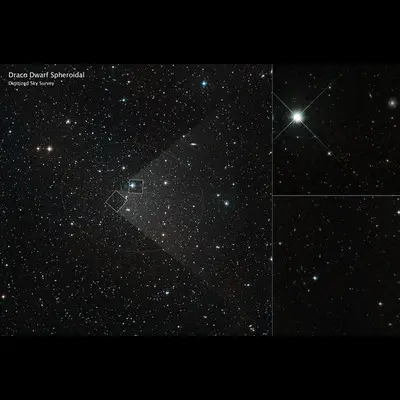
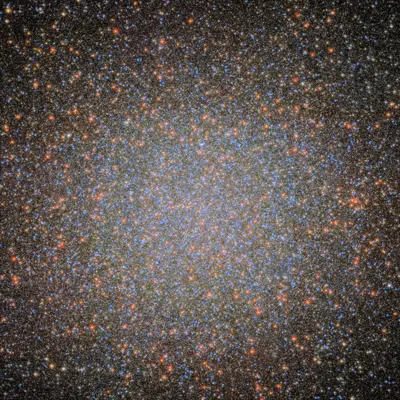
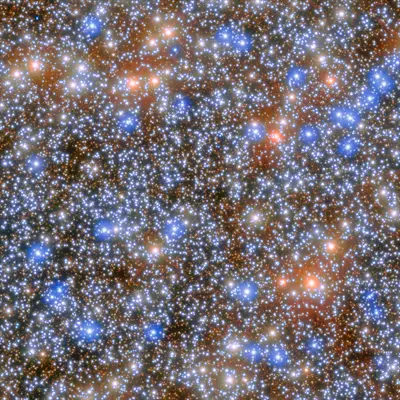
This image shows the location of the IMBH in Omega Centauri. If confirmed, at its distance of 17,700 light-years the candidate black hole resides closer to Earth than the 4.3-million-solar-mass black hole in the center of the Milky Way, which is 26,000 light-years away. Besides the Galactic center, it would also be the only known case of a number of stars closely bound to a massive black hole.
This image includes three panels. The first image at left shows the globular cluster Omega Centauri, a collection of myriad stars colored red, white, and blue on the black background of space. The second image shows the details of the central region of this cluster, with a closer view of the individual stars. The third image shows the location of the IMBH candidate in the cluster.
Detalles de la imagen
| About The Object | |
|---|---|
| Object Name | Omega Centauri, NGC 5139 |
| Object Description | Globular cluster |
| R.A. Position | 13:26:49.56 |
| Dec. Position | -47:29:32.66 |
| Constellation | Centaurus |
| Distance | 17,700 light-years |
| Dimensions | Image is about 9.2 arcminutes across (47 light-years) |
| About The Data | |
| Data Description | The HST observations include those from programs 9442 (A. Cool), (J. Anderson), (A. Sarajedini), (J. Lee), (L. Smith), (J. Anderson), (V. Kozhurina-Platais), (N. Hathi), (A. Bellini), (M. Chiaberge), (Y. Cohen), (N. Hathi), (N. Hathi), (J. Quijano), 11011 (C. Kochnek), (L. Petro), (E. Sabbi), (V. Kozhurina-Platais), (A. Renzini), (K. Long), (A. Riess), (V. Kozhurina-Platais), (J. MacKenty), (V. Kozhurina-Platais), (V. Kozhurina-Platais), (V. Kozhurina-Platais), (V. Kozhurina-Platais), (V. Kozhurina-Platais), (T. Brown), (V. Kozhurina-Platais), (V. Kozhurina-Platais), (V. Kozhurina-Platais), (V. Kozhurina-Platais), (A. Bellini), (M. Reinhart), (R. Bohlin), (J. Anderson), (V. Kozhurina-Platais), (A. Seth), and (C. Martlin). This dataset contains HST observations of the globular cluster Omega Centauri out to its half-light radius. The data were selected to contain all available observations with filters suitable for high-precision astrometry (ACS/WFC: F435W, F475W, F555W, F606W, F625W, F775W, F814W; WFC3/UVIS: F336W, F390W, F438W, F555W, F606W, F775W, F814W). In addition, the filters ACS/WFC F658N and WFC3/UVIS F275W were added for photometric purposes as they also cover almost the entire half-light radius. The data were taken in the time spanning from June 2002 to March 2023. They have been collectively compiled . |
| Instrument | WFC3/UVIS, ACS/WFC |
| Exposure Dates | 27 June 2002- 23 Feb 2024 |
| Filters | F275W, F336W, F438W, F606W, F625W, F658N, F814W |
| About The Image | |
| Color Info | These images are a composite of separate exposures acquired by the WFC3/UVIS instrument on the Hubble Space Telescope. Several filters were used to sample various wavelength ranges. The color results from assigning different hues (colors) to each monochromatic (grayscale) image associated with an individual filter. In this case, the assigned colors are: Blue= F275W + F336W + F438W, Green= F606W + F625W, Red= F658N + F814W |
Más imágenes de este periodo
Descargas
Fuente
La imagen y el material de referencia se acreditan al archivo oficial de la misión enlazado a continuación.
Ver en NASA.gov