Archivo de imágenes de Hubble
Pequeña nebulosa con mancuernas (imagen WFC3)
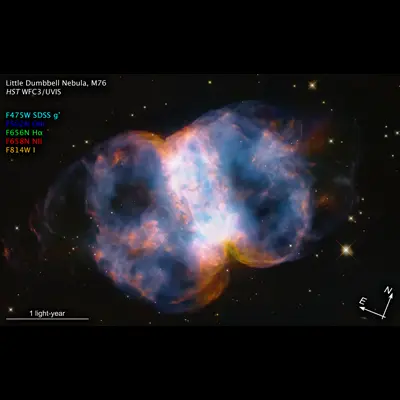
In celebration of the 34th anniversary of the launch of NASA’s legendary Hubble Space Telescope, astronomers took a snapshot of the Little Dumbbell Nebula, also known as Messier 76, or M76, located 3,400 light-years away in the northern circumpolar constellation Perseus. The name...
- Fecha
- Apr 23, 2024
- Misión
- Hubble Space Telescope
- ID de archivo
- hubblesite-images-2024-013-01htddbyv8rcs55y6g1k6fthr0

In celebration of the 34th anniversary of the launch of NASA’s legendary Hubble Space Telescope, astronomers took a snapshot of the Little Dumbbell Nebula, also known as Messier 76, or M76, located 3,400 light-years away in the northern circumpolar constellation Perseus. The name 'Little Dumbbell' comes from its shape that is a two-lobed structure of colorful, mottled, glowing gases resembling a balloon that’s been pinched around a middle waist. Like an inflating balloon, the lobes are expanding into space from a dying star seen as a white dot in the center. Blistering ultraviolet radiation from the super-hot star is causing the gases to glow. The red color is from nitrogen, and blue is from oxygen.
Credits
Image
NASA, ESA, STScI
Detalles de la imagen
| About The Object | |
|---|---|
| Object Name | Little Dumbbell Nebula, M76 |
| Object Description | Planetary Nebula |
| R.A. Position | 01:42:12 |
| Dec. Position | +51:34:56 |
| Constellation | Perseus |
| Distance | 3,400 light-years |
| Dimensions | Image is about 5 arcminutes across (about 5 light-years) |
| About The Data | |
| Data Description | The HST observations include those from program (C. Britt). Image Processing: Alyssa Pagan (STScI) |
| Instrument | WFC3/UVIS |
| Exposure Dates | 21 Jan - 23 Jan 2024 |
| Filters | F475W, F502N, F656N, F658N, F814W |
| About The Image | |
| Color Info | These images are a composite of separate exposures acquired by the WFC3/UVIS instrument on the Hubble Space Telescope. Several filters were used to sample various wavelength ranges. The color results from assigning different hues (colors) to each monochromatic (grayscale) image associated with an individual filter. In this case, the assigned colors are: Cyan= F475W, Blue= F502N, Green= F656N, Red= F658N, Orange= F814W |
Descargas
Fuente
La imagen y el material de referencia se acreditan al archivo oficial de la misión enlazado a continuación.
Ver en NASA.gov