Archivo de imágenes de Hubble
NGC 2292 y NGC 2293
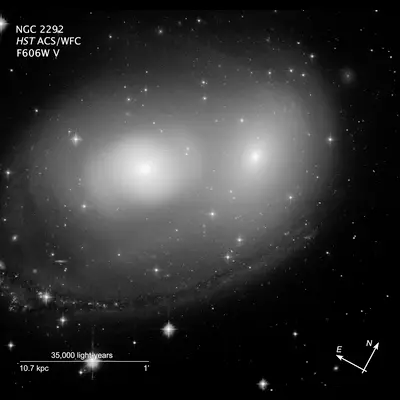
This is a Hubble Space Telescope snapshot of the early stages of a collision between two galaxies that resembles a Halloween carved pumpkin. The "pumpkin's" glowing “eyes” are the bright, star-filled cores of each galaxy that contain supermassive black holes. An arm of newly form...
- Fecha
- Jan 1, 2020
- Misión
- Hubble Space Telescope
- ID de archivo
- hubblesite-images-2020-32-4770-image

This is a Hubble Space Telescope snapshot of the early stages of a collision between two galaxies that resembles a Halloween carved pumpkin. The "pumpkin's" glowing “eyes” are the bright, star-filled cores of each galaxy that contain supermassive black holes. An arm of newly forming stars give the imaginary pumpkin a wry smirk. The two galaxies, cataloged as NGC 2292 and NGC 2293, are located about 120 million light-years away in the constellation Canis Major.
Credits
NASA, ESA, and W. Keel (University of Alabama)Detalles de la imagen
| About The Object | |
|---|---|
| Object Name | NGC 2292 and NGC 2293 |
| Object Description | Pair of Interacting Galaxies |
| R.A. Position | 06:47:39.65 |
| Dec. Position | -26:44:46.50 |
| Constellation | Canis Major |
| Distance | about 120 million light-years |
| Dimensions | Image is about 3 arcmin across (about 108,000 light-years) |
| About The Data | |
| Data Description | The HST observations include those from programs (W. Keel) |
| Instrument | ACS/WFC |
| Exposure Dates | 23 Jan 2020 |
| Filters | F606W |
| About The Image | |
| Color Info | These images are a composite of separate exposures acquired by the ACS/WFC instrument on the Hubble Space Telescope along with ground-based observations from the Pan-STARRS program. The color results from assigning different hues (colors) to each monochromatic image. In this case, the assigned colors are: Luminosity: F606W Blue: Pan-STARRS (g) Red: Pan-STARRS (z) The higher resolution, black & white Hubble image and the lower resolution, color Pan-STARRS images were combined using a technique that takes luminosity (brightness) information from the black and white ACS image and color information from the composite Pan-STARRS image. This preserves all of the higher-resolution detail from the Hubble data while also rendering a color image of this region of space. |
Más imágenes de este periodo
Fuente
La imagen y el material de referencia se acreditan al archivo oficial de la misión enlazado a continuación.
Ver en NASA.gov