Archivo de imágenes de Hubble
NGC 1333
Astronomers are celebrating NASA's Hubble Space Telescope’s 33rd launch anniversary with an ethereal photo of a nearby star-forming region, NGC 1333. The nebula is in the Perseus molecular cloud, and located approximately 960 light-years away. Hubble's colorful view, showcased th...
- Fecha
- Jan 1, 2023
- Misión
- Hubble Space Telescope
- ID de archivo
- hubblesite-images-2023-012-01gwqfkjje8vr2xvc09g43e9fr

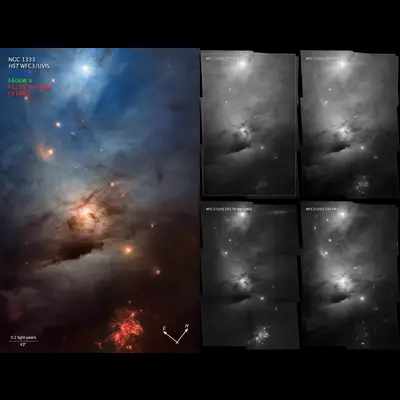
Astronomers are celebrating NASA's Hubble Space Telescope’s 33rd launch anniversary with an ethereal photo of a nearby star-forming region, NGC 1333. The nebula is in the Perseus molecular cloud, and located approximately 960 light-years away.
Hubble's colorful view, showcased through its unique capability to obtain images from ultraviolet to near-infrared light, unveils an effervescent cauldron of glowing gasses and pitch-black dust stirred up and blown around by several hundred newly forming stars embedded within the dark cloud. Hubble just scratches the surface because most of the star birthing firestorm is hidden behind clouds of fine dust – essentially soot – that are thicker toward the bottom of the image. The blackness in the image is not empty space, but filled with obscuring dust.
To capture this image, Hubble peered through a veil of dust on the edge of a giant cloud of cold molecular hydrogen – the raw material for fabricating new stars and planets under the relentless pull of gravity. The image underscores the fact that star formation is a messy process in our rambunctious universe.
Ferocious stellar winds, likely from the bright blue star at the top of the image, are blowing through a curtain of dust. The fine dust scatters the starlight at blue wavelengths.
Farther down, another bright super-hot star shines through filaments of obscuring dust, looking like the Sun shining through scattered clouds. A diagonal string of fainter accompanying stars looks reddish because dust is filtering starlight, allowing more of the red light to get through.
The bottom of the picture presents a keyhole peek deep into the dark nebula. Hubble captures the reddish glow of ionized hydrogen. It looks like a fireworks finale, with several overlapping events. This is caused by pencil-thin jets shooting out from newly forming stars outside the frame of view. These stars are surrounded by circumstellar disks, which may eventually produce planetary systems, and powerful magnetic fields that direct two parallel beams of hot gas deep into space, like a double light saber from science fiction films. They sculpt patterns on the hydrogen cocoon, like laser-light show tracings. The jets are a star's birth announcement.
This view offers an example of the time when our Sun and planets formed inside such a dusty molecular cloud, 4.6 billion years ago. Our Sun didn't form in isolation but was instead embedded inside a mosh pit of frantic stellar birth, perhaps even more energetic and massive than NGC 1333.
Hubble was deployed into orbit around Earth on April 25, 1990, by NASA astronauts aboard the Space Shuttle Discovery. To date, the legendary telescope has taken approximately 1.6 million observations of nearly 52,000 celestial targets. This treasure trove of knowledge about the universe is stored for public access in the Mikulski Archive for Space Telescopes, at the Space Telescope Science Institute in Baltimore, Maryland.
Credits
Science
NASA, ESA, STScI
Image Processing
Varun Bajaj (STScI), Joseph DePasquale (STScI), Jennifer Mack (STScI)
Detalles de la imagen
| About The Object | |
|---|---|
| Object Name | NGC 1333 |
| Object Description | Reflection Nebula |
| R.A. Position | 03:29:11.3 |
| Dec. Position | +31:18:36 |
| Constellation | Perseus |
| Distance | 967 light-years |
| Dimensions | Image is about 5.0 wide by 7.6 arcmin tall (about 1.4 by 2.1 light-years) |
| About The Data | |
| Data Description | The HST observations include those from program (C. Britt) |
| Instrument | WFC3/UVIS |
| Exposure Dates | December 2022 to March 2023 |
| Filters | F475W, F606W, F657N, F814W |
| About The Image | |
| Color Info | These images are a composite of separate exposures acquired by the WFC3 instrument on the Hubble Space Telescope. Several filters were used to sample wide and narrow wavelength ranges. The color results from assigning different hues (colors) to each monochromatic (grayscale) image associated with an individual filter. In this case, the assigned colors are: Blue: F475W, Green: F606W, Red: F657N and F814W |
Más imágenes de este periodo
Descargas
Fuente
La imagen y el material de referencia se acreditan al archivo oficial de la misión enlazado a continuación.
Ver en NASA.gov