Archivo de imágenes de Hubble
Extraíble: Galaxia enana "Peekaboo" HIPASS J1131–31
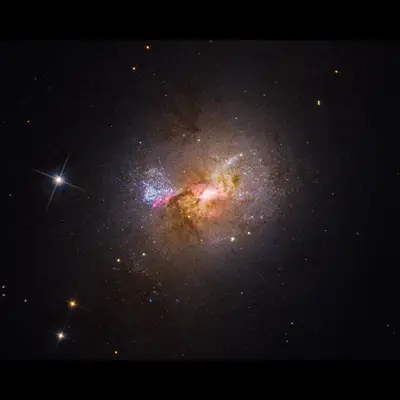
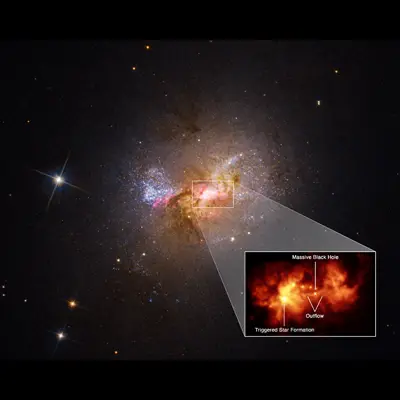
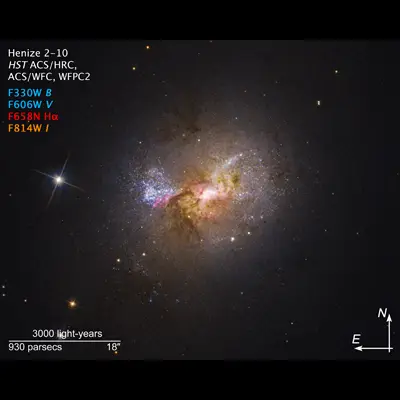
NASA's Hubble Space Telescope captured a detailed image of the tiny galaxy HIPASS J1131–31, nicknamed the "Peekaboo Galaxy," despite its proximity to a bright foreground star. In addition to Hubble imagery, astronomers used the South African Large Telescope (SALT) to collect deta...
- Fecha
- Jan 1, 2022
- Misión
- Hubble Space Telescope
- ID de archivo
- hubblesite-images-2022-051-01gje0180h4jfxq3bxfyc6rp7e

NASA's Hubble Space Telescope captured a detailed image of the tiny galaxy HIPASS J1131–31, nicknamed the "Peekaboo Galaxy," despite its proximity to a bright foreground star. In addition to Hubble imagery, astronomers used the South African Large Telescope (SALT) to collect detailed spectroscopic data on the galaxy's stars, which show it to be one of the least chemically enriched galaxies ever discovered in the local universe.
Typically, generations of stars produce more—and more complex—chemical elements (which astronomers call "metals") over cosmic time. At the dawn of the universe, 13.8 billion years ago, hydrogen and helium were the only abundant elements. Early galaxies that were made up of some of the first generations of stars had not had time to build up much chemical complexity. Evolved galaxies like our own Milky Way have stars that are many billions of years old and are metal-rich, including all the elements that make life on Earth possible. The stars of the Peekaboo Galaxy, however, appear to be only a few billion years old at most. Why, and how, the Peekaboo Galaxy delayed star-formation for so many billions of years is a question that astronomers will continue to investigate.
Credits
Science
NASA, ESA, Igor Karachentsev (SAO RAS)
Image Processing
Alyssa Pagan (STScI)
Detalles de la imagen
| About The Object | |
|---|---|
| Object Name | HIPASS J1131–31 |
| Object Description | Dwarf galaxy |
| R.A. Position | 11:31:35.2 |
| Dec. Position | -31:40:20 |
| Constellation | Hydra |
| Distance | About 22 million light-years (~6.8 Mpcs) |
| Dimensions | Image is approximately 3 arcminutes across (20,000 lys) |
| About The Data | |
| Data Description | This image was created from Hubble data from proposal: (R. B. Tully) |
| Instrument | ACS/WFC |
| Exposure Dates | 14 July 2020 |
| Filters | F606W, F814W |
| About The Image | |
| Color Info | These images are a composite of separate exposures acquired by the Hubble Space Telescope using the ACS/WFC instrument. Several filters were used to sample different wavelength ranges. The color results from assigning different hues (colors) to each monochromatic (grayscale) image associated with an individual filter. In this case, the assigned colors are: Cyan: F606W, Orange: F814W |
Descargas
Fuente
La imagen y el material de referencia se acreditan al archivo oficial de la misión enlazado a continuación.
Ver en NASA.gov