Archivo de imágenes de Hubble
Arrecife Cósmico (Imagen de la galería STScI)
Hubble Reveals a Tapestry of Blazing StarbirthThis Hubble image shows how young, energetic, massive stars illuminate and sculpt their birthplace with powerful winds and searing ultraviolet radiation.In this Hubble portrait, the giant red nebula (NGC 2014) and its smaller blue nei...
- Fecha
- Apr 24, 1990
- Misión
- Hubble Space Telescope
- ID de archivo
- hubblesite-images-4652-image

Hubble Reveals a Tapestry of Blazing Starbirth
This Hubble image shows how young, energetic, massive stars illuminate and sculpt their birthplace with powerful winds and searing ultraviolet radiation.
In this Hubble portrait, the giant red nebula (NGC 2014) and its smaller blue neighbor (NGC 2020) are part of a vast star-forming region in the Large Magellanic Cloud, a satellite galaxy of the Milky Way, located 163,000 light-years away. The image is nicknamed the "Cosmic Reef," because the nebulas resemble an undersea world.
The sparkling centerpiece of NGC 2014 is a grouping of bright, hefty stars, each 10 to 20 times more massive than our Sun. The stars' ultraviolet radiation heats the surrounding dense gas. The massive stars also unleash fierce winds of charged particles that blast away lower-density gas, forming the bubble-like structures seen on the right, which resemble coral. The stars' powerful stellar winds are pushing gas and dust to the denser left side of the nebula, where it is piling up, creating a series of dark ridges bathed in starlight. The blue areas in NGC 2014 reveal the glow of oxygen, heated to nearly 20,000 degrees Fahrenheit by the blast of ultraviolet light. The cooler, red gas indicates the presence of hydrogen and nitrogen.
By contrast, the seemingly isolated blue nebula at lower left (NGC 2020) has been created by a solitary mammoth star 200,000 times brighter than our Sun. The blue gas was ejected by the star through a series of eruptive events during which it lost part of its outer envelope of material.
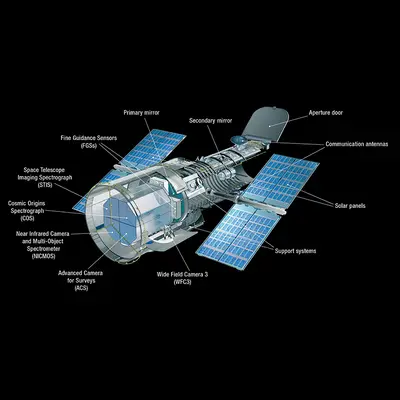
The image, taken by Hubble's Wide Field Camera 3, commemorates the Earth-orbiting observatory's 30 years in space.
Hubble Trivia
Launched on April 24, 1990, NASA's Hubble Space Telescope has made more than 1.4 million observations of nearly 47,000 celestial objects. More than 900,000 observations were taken with imaging instruments.
In its 30-year lifetime the telescope has racked up more than 175,000 trips around our planet, totaling about 4.4 billion miles.
Hubble observations have produced nearly 164 terabytes of data, which are available for present and future generations of researchers.
Astronomers using Hubble data have published more than 17,000 scientific papers, with more than 1,000 of those papers published in 2019.
Detalles de la imagen
| About The Object | |
|---|---|
| Object Name | NGC 2020 and NGC 2014 |
| Object Description | Wolf-Rayet Nebula and Star Forming Region |
| R.A. Position | 05:32:23.71 |
| Dec. Position | -67:42:05.62 |
| Constellation | Dorado |
| Distance | The object lies 163,000 light-years away from Earth. |
| Dimensions | The image is 11 arcminutes across (about 520 light-years). |
| About The Data | |
| Data Description | The HST observations include those from programs M. Mutchler. High-level science products for these data are available from the . |
| Instrument | WFC3/UVIS |
| Exposure Dates | Jan-Feb 2020 |
| Filters | F475W, F502N, F657N, F814W |
| About The Image | |
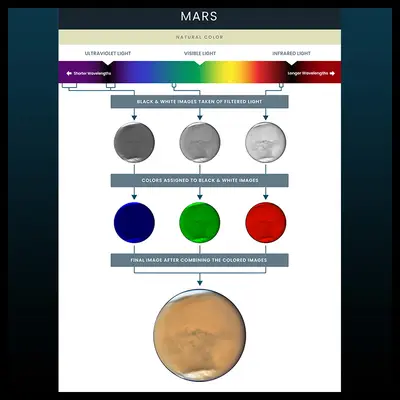
| Color Info | These images are a composite of separate exposures acquired by the WFC3/UVIS instrument on the Hubble Space Telescope. Several filters were used to sample narrow wavelength ranges. The color results from assigning different hues (colors) to each monochromatic (grayscale) image associated with an individual filter. In this case, the assigned colors are: Blue: F475W Cyan: F502N Orange: F657N Red: F814W |
Descargas
Fuente
La imagen y el material de referencia se acreditan al archivo oficial de la misión enlazado a continuación.
Ver en NASA.gov