Archivo de imágenes de Hubble
Campo ultraprofundo del Hubble
This tiny slice of the universe, speckled with galaxies near and far, tells the story of galaxy evolution over cosmic time. Among the 10,000 or so galaxies pictured here are newborns, adolescents, adults, and retirees. Like looking through a vast collection of family photos, astr...
- Fecha
- Apr 24, 1990
- Misión
- Hubble Space Telescope
- ID de archivo
- hubblesite-images-3886-image

This tiny slice of the universe, speckled with galaxies near and far, tells the story of galaxy evolution over cosmic time. Among the 10,000 or so galaxies pictured here are newborns, adolescents, adults, and retirees. Like looking through a vast collection of family photos, astronomers are poring over this comprehensive image to see how galaxies grew up, matured, and aged.
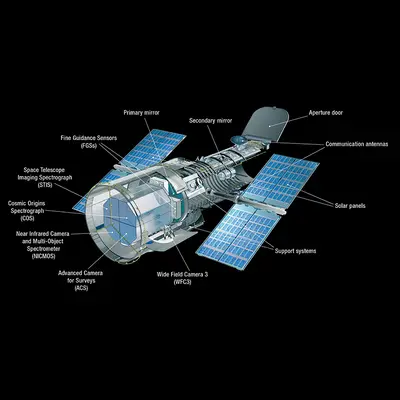
This portrait of our universe's history is called the Hubble Ultra Deep Field (or HUDF). It is a minuscule patch of sky first targeted by the Hubble Space Telescope in 2002 and revisited over and over again since then. This version of the HUDF is extra special, though. It combines observations of the field taken with Hubble's Advanced Camera for Surveys and the Wide Field Camera 3 from 2002 to 2012, providing one of the farthest views into the universe we've ever seen. Plus, it includes light not just from the visible part of the spectrum but from the (invisible) infrared and ultraviolet ranges, too, giving us different details of the story of how galaxies came to be.
Infrared light lets us see the universe's youngest galaxies. These galaxies lie far, far away from us, and as their light travels across the universe, it gets stretched by the expansion of space. Wavelengths of visible light grow longer, becoming infrared light by the time it reaches us. Combining Hubble's observations of the HUDF in visible and infrared light, a team of astronomers led by Garth Illingworth of the University of California identified more than 5,500 galaxies in a central portion of the field, some so faint that they are just one ten-billionth the brightness of what the human eye can see. Another team, headed by Richard Ellis of the California Institute of Technology (Caltech), used Hubble's infrared observations to find galaxies more than 13 billion light-years away, when the universe was only about 400 million years old — or about three percent of its present age.
Alternatively, to understand slightly older, growing galaxies that are not so far away, observing in ultraviolet light is best. The hottest and youngest stars give off huge amounts of ultraviolet light, making them easy to spot at those wavelengths of light. Most recently, a team of astronomers led by Harry Teplitz of Caltech used the ultraviolet-sensing abilities of Hubble's Wide Field Camera 3 to add the ultraviolet piece to this view of the HUDF. With this part of the galaxy evolution picture in hand, astronomers are investigating how galaxies grew through bursts of star formation and exactly where, when, and how many stars formed over time.
Because our atmosphere blocks or absorbs most infrared and ultraviolet light that reaches Earth, only a telescope in space, like Hubble, can provide such insights into the history of galaxies. Without both infrared and ultraviolet light, the tale is incomplete.
Exposure credits:
- 2004 HUDF IMAGE – NASA, ESA, S. Beckwith, M. Stiavelli, A. Koekemoer (STScI), R. Thompson (University of Arizona), and the STScI HUDF Team
- 2009 HUDF IMAGE – NASA, ESA, G. Illingworth, R. Bouwens (University of California, Santa Cruz), and the HUDF09 Team
- 2012 HUDF IMAGE – NASA, ESA, R. Ellis (Caltech), R. McLure, J. Dunlop (University of Edinburgh), B. Robertson (University of Arizona), A. Koekemoer (STScI), and the HUDF12 Team
- 2012 XDF IMAGE – NASA, ESA, G. Illingworth, D. Magee, P. Oesch (University of California, Santa Cruz), R. Bouwens (Leiden University), and the HUDF09 Team
- 2014 HUDF / UV-UDF IMAGE – NASA, ESA, H. Teplitz, M. Rafelski (IPAC/Caltech), A. Koekemoer (STScI), R. Windhorst (Arizona State University), and Z. Levay (STScI)
Credits
Image
NASA, ESA, H. Teplitz (IPAC, Caltech), M. Rafelski (IPAC, Caltech), Anton M. Koekemoer (STScI), Rogier Windhorst (ASU), Zolt G. Levay (STScI)
Detalles de la imagen
| About The Object | |
|---|---|
| Object Name | Hubble Ultra Deep Field 2014 (HUDF 2014) |
| Object Description | Ultraviolet, Optical, and Infrared Survey |
| R.A. Position | 03h 32m 38.99s |
| Dec. Position | -27° 47' 29.04" |
| Constellation | Fornax |
| Distance | 13.2 billion light-years |
| About The Data | |
| Data Description | The image was created from Hubble data from the following proposals: , , , : A. Riess (STScI/JHU); : M. Giavalisco (University of Massachusetts); : K. Ratnatunga (Carnegie Mellon University); : W. Sparks (STScI); , : S. Malhotra (Arizona State University); , : S. Beckwith (STScI); : H. Teplitz (Caltech); : C. Kretchmer (JHU); : R. O'Connell (University of Virginia); : G. Illingworth (University of California, Santa Cruz); , , : S. Faber (University of California, Santa Cruz) and H. Ferguson (STScI); : P. van Dokkum (Yale University); : R. Ellis (Caltech); and : H. Teplitz (Caltech). THE SCIENCE TEAM: H. Teplitz and M. Rafelski (IPAC/Caltech), P. Kurczynski (Rutgers University), N. Bond (NASA/Goddard Space Flight Center), E. Soto (Catholic University), N. Grogin and A. Koekemoer (STScI), H. Atek (École Polytechnique Fédérale de Lausanne, Switzerland), T. Brown and D. Coe (STScI), J. Colbert and Y. Dai (IPAC/Caltech), H. Ferguson (STScI), S. Finkelstein (University of Texas, Austin), J. Gardner (Goddard Space Flight Center), E. Gawiser (Rutgers University), M. Giavalisco (University of Massachusetts, Amherst), C. Gronwall (Penn State University), D. Hanish (IPAC/Caltech), K.-S. Lee (Purdue University), Z. Levay (STScI), D. De Mello (Catholic University), S. Ravindranath and R. Ryan (STScI), B. Siana (University of California, Riverside), C. Scarlata (University of Minnesota, Minneapolis), E. Voyer (CNRS, Marseille), and R. Windhorst (Arizona State University). |
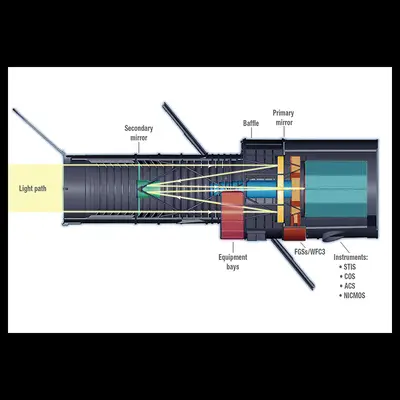
| Instrument | Advanced Camera for Surveys/WFC and /SBC, and Wide Field Camera 3/IR and /UVIS |
| Exposure Dates | July 2002 – September 2012, Exposure Time: ~600 hours |
| Filters | ACS/SBC: F150LP; WFC3/UVIS: F225W (U), F275W (U), F336W (U); ACS/WFC: F435W (B), F606W (V), F775W (I), F814W (I), F850LP (z); WFC3/IR: F105W (Y), F125W (J), F140W (JH), F160W (H) |
| About The Image | |
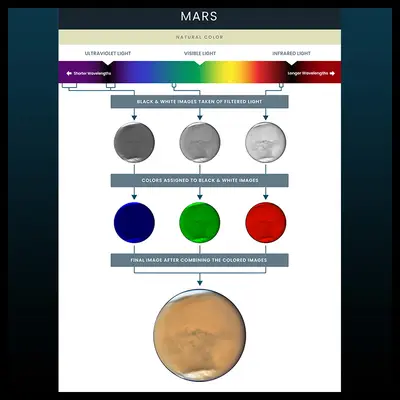
| Color Info | This image is a composite of separate exposures acquired by the ACS/SBC, ACS/WFC, WFC3/UVIS and WFC3/IR instruments. Several filters were used to sample various wavelengths. The color results from assigning different hues (colors) to each monochromatic (grayscale) image from the 13 different filters used by the four instruments grouped as follows: Blue: ACS/SBC F150LP, WFC3/UVIS F225W (U) + F275W (U) + F336W (U), ACS/WFC F435W (B) + F606W (V) + Green: ACS/WFCF775W (I) + F814W (I) + F850LP (z), WFC3/IR F105W (Y) Red: WFC3/IR F125W (J) + F140W (JH) + F160W (H) |
Descargas
Fuente
La imagen y el material de referencia se acreditan al archivo oficial de la misión enlazado a continuación.
Ver en NASA.gov