Archivo de imágenes de Hubble
Makemake y su luna
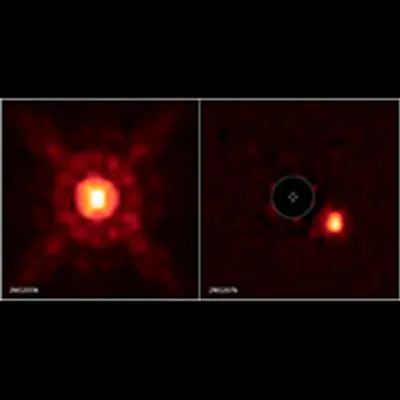
This Hubble Space Telescope image reveals the first moon ever discovered around the dwarf planet Makemake. The tiny moon, located just above Makemake in this image, is barely visible because it is almost lost in the glare of the very bright dwarf planet. The moon, nicknamed MK 2,...
- Fecha
- Jan 1, 2016
- Misión
- Hubble Space Telescope
- ID de archivo
- hubblesite-images-2016-18-3739-image

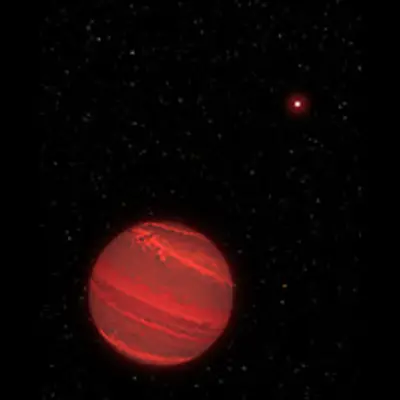
This Hubble Space Telescope image reveals the first moon ever discovered around the dwarf planet Makemake. The tiny moon, located just above Makemake in this image, is barely visible because it is almost lost in the glare of the very bright dwarf planet. The moon, nicknamed MK 2, is roughly 100 miles wide and orbits about 13,000 miles from Makemake. Makemake is 1,300 times brighter than its moon and is also much larger, at 870 miles across.
The Makemake system is more than 50 times farther than the Earth is from the sun. The pair resides on the outskirts of our solar system in the Kuiper Belt, a vast region of frozen debris from the construction of our solar system 4.5 billion years ago.
Previous searches for a moon around Makemake turned up empty. The moon may be in an edge-on orbit, so part of the time it gets lost in the bright glare of Makemake.
Hubble's sharp-eyed Wide Field Camera 3 made the observation in April 2015.
Credits
NASA, ESA, A. Parker and M. Buie (Southwest Research Institute), W. Grundy (Lowell Observatory), and K. Noll (NASA GSFC)Detalles de la imagen
| About The Object | |
|---|---|
| Object Name | Makemake, Dwarf Planet (136472), and its Moon S/2015 (136472) 1, MK 2 |
| Object Description | Kuiper Belt Object, Dwarf Planet (136472) Makemake (870 miles in diameter) and moon S/2015 (136472) 1, MK 2 (100 miles in diameter) |
| R.A. Position | 12h 49m 39.0s |
| Dec. Position | 26° 22' 12.0" |
| Constellation | Coma Berenices |
| About The Data | |
| Data Description | The HST data were taken from proposal PI: M. Buie (Southwest Research Institute), W. Grundy (Lowell Observatory), and K. Noll (NASA Goddard Space Flight Center). The science team comprises A. Parker and M. Buie (Southwest Research Institute), W. Grundy (Lowell Observatory), and K. Noll (NASA Goddard Space Flight Center). |
| Instrument | HST>WFC3 |
| Exposure Dates | April 27/29, 2015, Exposure Time: 4,350 seconds |
| Filters | F350LP |
Descargas
Fuente
La imagen y el material de referencia se acreditan al archivo oficial de la misión enlazado a continuación.
Ver en NASA.gov