Archivo de imágenes de Hubble
Galaxia enana cerca de M60
Looking almost like a bright star near the massive elliptical galaxy M60 (also called NGC 4649), the dwarf galaxy M60-UCD1 crams 140 million stars within a diameter of about 300 light-years. The dwarf galaxy may actually be the stripped remnant of a larger galaxy that was torn ap...
- Fecha
- Jan 1, 2014
- Misión
- Hubble Space Telescope
- ID de archivo
- hubblesite-images-2014-41-3426-image
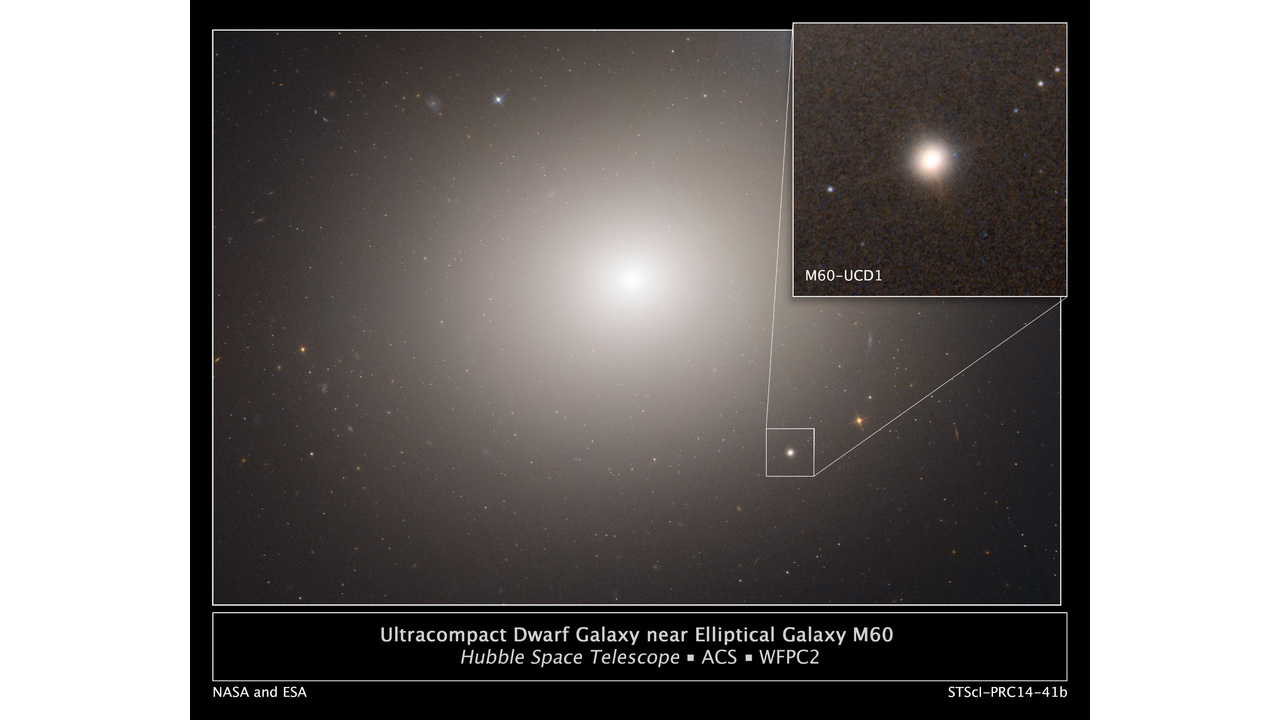
Looking almost like a bright star near the massive elliptical galaxy M60 (also called NGC 4649), the dwarf galaxy M60-UCD1 crams 140 million stars within a diameter of about 300 light-years. The dwarf galaxy may actually be the stripped remnant of a larger galaxy that was torn apart during a close encounter with the more massive galaxy. Circumstantial evidence comes from the recent discovery of a monster black hole (too small to be seen in this Hubble Space Telescope picture) at the center of the dwarf. The black hole is 15 percent the mass of the entire galaxy – way too big for it to have formed inside a dwarf galaxy. But the black hole would be the right proportional mass if the galaxy had once been more massive. The galaxy lies 50 million light-years away inside the immense Virgo Cluster of 2,500 galaxies. M60-UCD1 orbits the giant elliptical galaxy in this image. M60 is 120 million light-years across and contains an estimated 400 billion stars.
Credits
NASA, ESA, and the Hubble Heritage (STScI/AURA)-ESA/Hubble Collaboration;Acknowledgment: J. Tonry (University of Hawaii), P. Cote (Dominion Astrophysical Observatory), and G. Fabbiano (Harvard-Smithsonian Center for Astrophysics)
Detalles de la imagen
| About The Object | |
|---|---|
| Object Name | Messier 60, M60, and M60-UCD1 |
| Object Description | Elliptical Galaxy and Ultracompact Dwarf Galaxy with Black Hole |
| R.A. Position | 12h 43m 36.0s |
| Dec. Position | 11° 32' 6.99" |
| Constellation | Virgo |
| Distance | M60 and M60-UCD1 are roughly 54 million light-years (16 megaparsecs) distant. |
| About The Data | |
| Data Description | Data for this science result comes from the HST proposal: G. Fabbiano (Harvard-Smithsonian Center for Astrophysics), T. Fragos and V. Kalogera (Northwestern University), D.-W. Kim and A. Zezas (Harvard-Smithsonian Center for Astrophysics), J. Gallagher III (University of Wisconsin, Madison) , A. King (University of Leicester), J. Strader (Harvard University), and J. Brodie (University of California, Santa Cruz). The release image of M60 also includes data from proposals , PI: J. Tonry (University of Hawaii) and , PI: P. Cote (Dominion Astrophysical Observatory). The science team comprises: A. Seth (University of Utah), R. van den Bosch (Max Planck Institute for Astronomy, Heidelberg), S. Mieske (ESO Chile), H. Baumgardt (University of Queensland), M. den Brok (University of Utah), J. Strader (Michigan State University), N. Neumayer (ESO Garching), I. Chilingarian (Harvard-Smithsonian Center for Astrophysics/Moscow State University), M. Hilker (ESO Garching), R. McDermid and L. Spitler (Australian Astronomical Observatory/Macquarie University, Sydney), J. Brodie (University of California, Santa Cruz), M. Frank (Center of Astronomy/Heidelberg University), and J. Walsh (University of Texas, Austin). |
| Instrument | HST>ACS/WFC and HST>WFPC2 |
| Filters | ACS/WFC: F475W (B) and F850LP (z); WFPC2: F555W (V) and F814W (I) |
| About The Image | |
| Color Info | The images are composites of separate exposures made by the ACS/WFC and WFPC2 instruments on the Hubble Space Telescope. Four filters were used to sample broad and narrow wavelength ranges for the UVIS image. The colors result from assigning different hues (colors) to each monochromatic image. In this case, the assigned colors are: Blue: ACS/WFC F475W (B) + WFPC2 F555W (V) Green: F475W (B) + F555W (V) + F850LP (z) + F814W (I) Red: ACS/WFC F850LP (z) + WFPC2 F814W (I) |
Más imágenes de este periodo
Descargas
Fuente
La imagen y el material de referencia se acreditan al archivo oficial de la misión enlazado a continuación.
Ver en NASA.gov