Archivo de imágenes de Hubble
Pequeñas galaxias repletas de nacimiento de estrellas en el campo GOODS
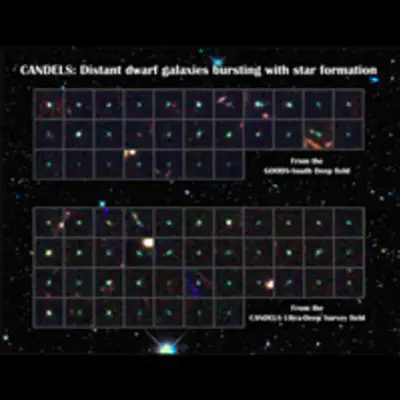
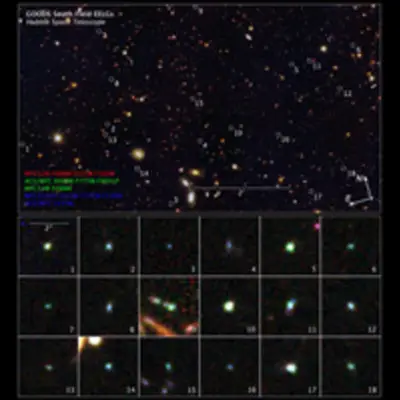
This image reveals 18 tiny galaxies uncovered by NASA's Hubble Space Telescope. The puny galaxies, shown in the postage-stamp-sized images, existed 9 billion years ago and are brimming with star birth.The dwarf galaxies are typically a hundred times less massive than the Milky Wa...
- Fecha
- Jan 1, 2011
- Misión
- Hubble Space Telescope
- ID de archivo
- hubblesite-images-2011-31-2911-image

This image reveals 18 tiny galaxies uncovered by NASA's Hubble Space Telescope. The puny galaxies, shown in the postage-stamp-sized images, existed 9 billion years ago and are brimming with star birth.
The dwarf galaxies are typically a hundred times less massive than the Milky Way galaxy but are churning out stars at such a furious pace that their stellar content would double in just 10 million years. Hubble's Wide Field Camera 3 and Advanced Camera for Surveys spied the galaxies in the Great Observatories Origins Deep Survey (GOODS) field. The galaxies' locations in the GOODS field are marked by circles in the large image.
The galaxies stood out in the Hubble images because the energy from all the new stars caused the oxygen in the gas surrounding them to light up like a bright neon sign. The rapid star birth likely represents an important phase in the formation of dwarf galaxies, the most common galaxy type in the cosmos.
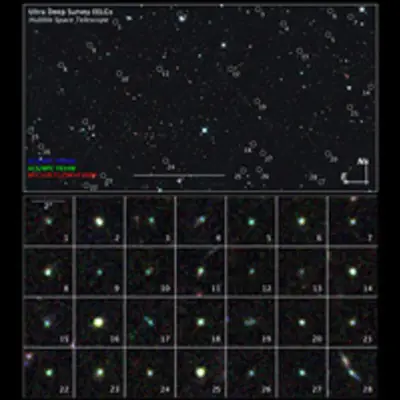
The galaxies are among 69 dwarf galaxies found in the GOODS and other fields.
Images of the individual galaxies were taken November 2010 to January 2011. The large image showing the locations of the galaxies was taken between September 2002 and December 2004, and between September 2009 and October 2009.
Credits
NASA, ESA, A. van der Wel (Max Planck Institute for Astronomy, Heidelberg, Germany), H. Ferguson and A. Koekemoer (Space Telescope Science Institute, Baltimore, Md.), and the CANDELS teamDetalles de la imagen
| About The Object | |
|---|---|
| Object Name | GOODS South Deep (GSD) and Distant galaxies |
| Object Description | Galactic survey (top) and distant galaxies (bottom) |
| R.A. Position | 03h 32m 30.0s |
| Dec. Position | -27° 48' 20.0" |
| Constellation | Fornax |
| About The Data | |
| Data Description | The image was created from Hubble WFC3 data from proposal , R. O'Connell (University of Virginia) and collaborators, combined with Hubble ACS GOODS v2.0 data, which includes data from proposal : M. Giavalisco (University of Massachusetts) et al., and proposal : A. Riess (JHU and STScI). The science team for this release is led by A. van der Wel (Max Planck Institute for Astronomy, Heidelberg, Germany), and the images were produced by A. Koekemoer (STScI). |
| Instrument | HST>ACS/WFC, HST>WFC3/UVIS, and HST>WFC3/IR |
| Exposure Dates | September 2002 - December 2004, and September 2009 - October 2009 (top) November 2010 to January 2011 (bottom) |
| Filters | WFC3/UVIS: F225W (UV), F275W (UV), and F336W (U) ACS/WFC: F435W (B), F606W (V), F775W (i), and F850LP (z) WFC3/IR: F098M (blue grism), F125W (J), and F160W (H) |
| About The Image | |
| Color Info | This image is a composite of many separate exposures made by the ACS and WFC3 instruments on the Hubble Space Telescope using different filters that isolate broad wavelengths. The color results from assigning different hues (colors) to each monochromatic image. In this case, the assigned colors are: Blue: F225W (UV) + F275W (UV) + F336W (U) + F435W (B) Green: F098M (blue grism) + F606W (V) + F775W (i) + F850LP (z) Red: F098M (blue grism) + F125W (J) + F160W (H) |
Descargas
Fuente
La imagen y el material de referencia se acreditan al archivo oficial de la misión enlazado a continuación.
Ver en NASA.gov