Archivo de imágenes de Hubble
Galaxias distantes en GOODS North
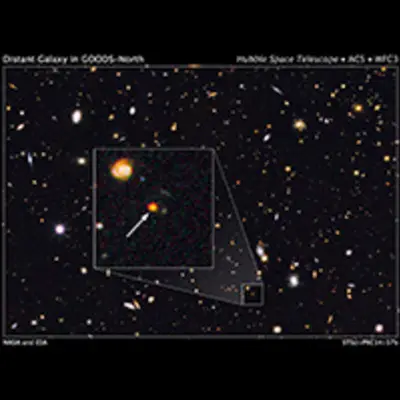
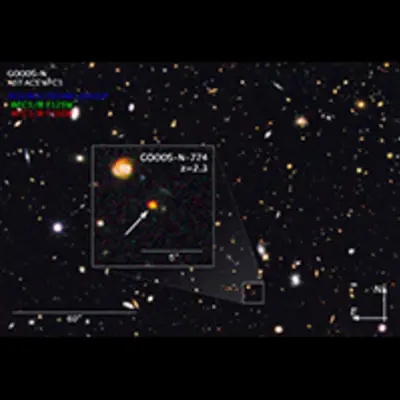
This is a portion of a deep-sky Hubble Space Telescope survey called GOODS North (Great Observatories Origins Deep Survey). The view is a composite of images taken in visible and near-infrared light. Researchers have circled four unusually red objects that appear as they existed...
- Fecha
- Jan 1, 2014
- Misión
- Hubble Space Telescope
- ID de archivo
- hubblesite-images-2014-05-3296-image

This is a portion of a deep-sky Hubble Space Telescope survey called GOODS North (Great Observatories Origins Deep Survey). The view is a composite of images taken in visible and near-infrared light. Researchers have circled four unusually red objects that appear as they existed just 500 million years after the big bang. They appear red because their light has been stretched to longer infrared wavelengths by the expansion of the universe. These extremely compact and bright galaxies present a puzzle to researchers because they are much more luminous than anything previously seen at such an early epoch. The young galaxies are bright because they are forming stars at a much faster rate than for other galaxies found at such early times.
The science team members are G. Illingworth (University of California, Santa Cruz), P. Oesch (University of California, Santa Cruz; Yale University), R. Bouwens, I. Labbé, R. Smit, and M. Franx (Leiden University), P. van Dokkum and I. Momcheva (Yale University), M. Ashby, G. Fazio, J.-S. Huang, and S. Willner (Harvard-Smithsonian Center for Astrophysics), V. Gonzalez (University of California, Riverside), D. Magee (University of California, Santa Cruz), M. Trenti (University of Cambridge), G. Brammer (STScI), R. Skelton (South African Astronomical Observatory), and L. Spitler (Macquarie University/Anglo-Australian Observatory).
Credits
NASA, ESA, G. Illingworth (University of California, Santa Cruz), P. Oesch (University of California, Santa Cruz; Yale University), R. Bouwens and I. Labbé (Leiden University), and the Science TeamDetalles de la imagen
| About The Object | |
|---|---|
| Object Name | GOODS-N |
| Object Description | Optical/Infrared Survey with distant galaxies |
| R.A. Position | 12h 36m 37.9s |
| Dec. Position | 62° 18' 8.49" |
| Constellation | Ursa Major |
| About The Data | |
| Data Description | The science team members are G. Illingworth (University of California, Santa Cruz), P. Oesch (University of California, Santa Cruz; Yale University), R. Bouwens, I. Labbé, R. Smit, and M. Franx (Leiden University), P. van Dokkum and I. Momcheva (Yale University), M. Ashby, G. Fazio, J.-S. Huang, and S. Willner (Harvard-Smithsonian Center for Astrophysics), V. Gonzalez (University of California, Riverside), D. Magee (University of California, Santa Cruz), M. Trenti (University of Cambridge), G. Brammer (STScI), R. Skelton (South African Astronomical Observatory), and L. Spitler (Macquarie University/AAO). |
| Instrument | HST>ACS/WFC and HST>WFC3/IR |
| Filters | GOODS-N ACS/WFC: F435W (B), F606W (V), F814W (I), and F850LP (z) WFC3/IR: F125W (J) and F160W (H) Distant galaxies, inset F105W (Y), F125W (J) and F160W (H) |
| About The Image | |
| Color Info | The main GOODS-N composite includes exposures acquired by the ACS and WFC3 instruments on the Hubble Space Telescope. Several filters were used to sample broad wavelength ranges. The color results from assigning different hues (colors) to each monochromatic (grayscale) image associated with an individual filter. In this case, the assigned colors are: GOODS-N Blue: F435W (B) + F606W (V) Green: F814W (I) + F850LP (z) Red: F125W (J) + F160W (H) Distant galaxies, inset Blue: F105W Green: F125W Red: F160W |
Más imágenes de este periodo
Descargas
Fuente
La imagen y el material de referencia se acreditan al archivo oficial de la misión enlazado a continuación.
Ver en NASA.gov