Archivo de imágenes de Hubble
Fusionando grupos en 30 Doradus
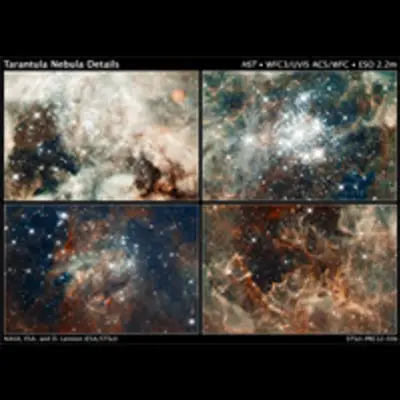
This is a Hubble Space Telescope image of a pair of star clusters that are believed to be in the early stages of merging. The clusters lie in the gigantic 30 Doradus Nebula, which is 170,000 light-years from Earth.Hubble's circumstantial evidence for the impending collision comes...
- Fecha
- Jan 1, 2012
- Misión
- Hubble Space Telescope
- ID de archivo
- hubblesite-images-2012-35-3085-image

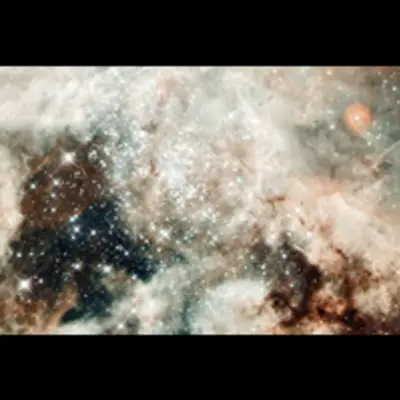
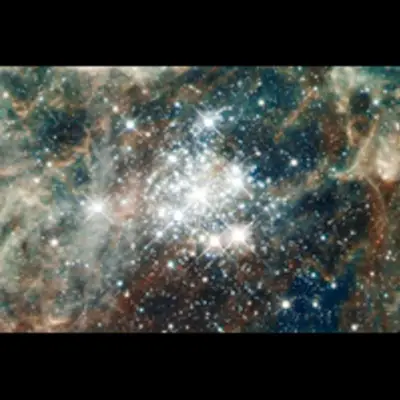
This is a Hubble Space Telescope image of a pair of star clusters that are believed to be in the early stages of merging. The clusters lie in the gigantic 30 Doradus Nebula, which is 170,000 light-years from Earth.
Hubble's circumstantial evidence for the impending collision comes from seeing an elongated structure in the cluster at upper left, and from measuring a different age between the two clusters. Also, the unusually large number of high-velocity stars around 30 Doradus can finally be explained if a small cluster has merged into the big cluster R136 in the center of the Tarantula Nebula.
This nearby example of cluster interaction yields insights into how star clusters may have formed in the early universe.
The Hubble observations, made with the Wide Field Camera 3, were taken Oct. 20-27, 2009. The blue color is light from the hottest, most massive stars; the green from the glow of oxygen; and the red from fluorescing hydrogen.
Credits
Image: NASA, ESA, and E. Sabbi (ESA/STScI);Acknowledgment: R. O'Connell (University of Virginia) and the Wide Field Camera 3 Science Oversight Committee
Detalles de la imagen
| About The Object | |
|---|---|
| Object Name | 30 Doradus, 30 Dor, Tarantula Nebula |
| Object Description | Nebula in the Large Magellanic Cloud |
| R.A. Position | 05h 38m 42.36s |
| Dec. Position | -69° 6' 3.24" |
| Constellation | Dorado |
| Distance | 170,000 light-years (52,000 parsecs) |
| About The Data | |
| Data Description | The image was created from Hubble data from proposal : R. O'Connell (University of Virginia), B. Balick (University of Washington), H. Bond (STScI), D. Calzetti (University of Massachusetts), M. Carollo (Swiss Federal Institute of Technology, Zurich), M. Disney (University of Wales, College of Cardiff), M. Dopita (Australian National University), J. Frogel (Ohio State University Research Foundation), D. Hall (University of Hawaii), J. Holtzman (New Mexico State University), P. McCarthy (Carnegie Institution of Washington), F. Paresce (European Southern Observatory, Germany), A. Saha (NOAO/AURA), J. Silk (University of Oxford), A. Walker (NOAO/CTIO), B. Whitmore (STScI), R. Windhorst (Arizona State University), and E. Young (University of Arizona). The members of the science team are: E. Sabbi and D.J. Lennon (ESA/STScI), M. Gieles (University of Cambridge, UK), S.E. de Mink (STScI/JHU), N.R. Walborn, J. Anderson, A. Bellini, N. Panagia, and R. van der Marel (STScI), and J. Maíz Apellániz (Instituto de Astrofísica de Andalucía, CISC, Spain). |
| Instrument | HST>WFC3/UVIS and HST>WFC/IR |
| Exposure Dates | October 20 - 27, 2009 (WFC3/UVIS), and October 20 - 27, 2009 (WFC/IR), Exposure Times: 11.7 hours, and 2.6 hours |
| Filters | F336W (U), F438W (B), F555W (V), F656N (H-alpha), and F814W (I) |
| About The Image | |
| Color Info | The images are composites of separate exposures made by the WFC3 instrument on the Hubble Space Telescope. Five filters were used to sample broad and narrow wavelength ranges for the UVIS image. The colors result from assigning different hues (colors) to each monochromatic image. In this case, the assigned colors are: WFC3/UVIS image of 30 Dor Blue: F336W (U) + F438W (B) Green: F555W (V) Red: F814W (I) Orange/red: F656N (H-alpha) |
Descargas
Fuente
La imagen y el material de referencia se acreditan al archivo oficial de la misión enlazado a continuación.
Ver en NASA.gov