Archivo de imágenes de Hubble
30 Nebulosa Doradus y cúmulos de estrellas
This is a Hubble Space Telescope image of a pair of star clusters that are believed to be in the early stages of colliding. The clusters lie in the gigantic 30 Doradus Nebula, which is 170,000 light-years from Earth.Hubble's circumstantial evidence for the impending collision com...
- Fecha
- Jan 1, 2012
- Misión
- Hubble Space Telescope
- ID de archivo
- hubblesite-images-2012-35-3088-image
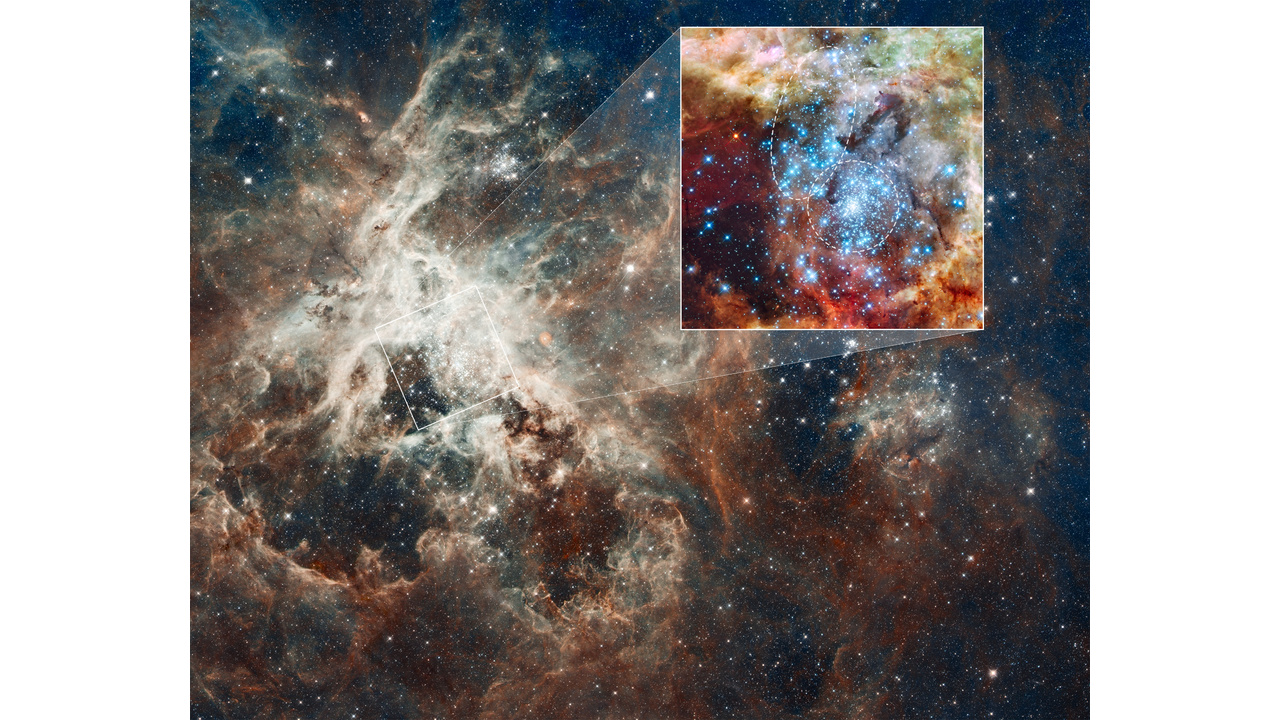
This is a Hubble Space Telescope image of a pair of star clusters that are believed to be in the early stages of colliding. The clusters lie in the gigantic 30 Doradus Nebula, which is 170,000 light-years from Earth.
Hubble's circumstantial evidence for the impending collision comes from seeing an elongated structure in the cluster at upper left, and from measuring a different age between the two clusters.
Also, there is an unusually large number of high-velocity stars expelled from the region. This is a normal byproduct of a process called core collapse, in which more-massive stars sink to the center of a cluster by ejecting lower-mass stars. However, both clusters are too young to have experienced core collapse. The ejected stars can be better explained if the two clusters are merging.
This nearby example of cluster interaction yields insights into how star clusters may have formed in the early universe.
The Hubble image at upper right was made with Wide Field Camera 3 observations taken Oct. 20-27, 2009. The blue color is light from the hottest, most massive stars; the green from the glow of oxygen; and the red from fluorescing hydrogen.
The colors in the wide-field image, made with Hubble's Wide Field Camera 3 and the Advanced Camera for Surveys, represent the hot gas that dominates regions of the image. Red signifies hydrogen gas and blue, oxygen. Hubble made the photo mosaic in October 2011.
Credits
NASA, ESA, D. Lennon and E. Sabbi (ESA/STScI), J. Anderson, S.E. de Mink, R. van der Marel, T. Sohn, and N. Walborn (STScI), N. Bastian (Excellence Cluster, Munich), L. Bedin (INAF, Padua), E. Bressert (ESO), P. Crowther (University of Sheffield), A. de Koter (University of Amsterdam), C. Evans (UKATC/STFC, Edinburgh), A. Herrero (IAC, Tenerife), N. Langer (AifA, Bonn), I. Platais (JHU), and H. Sana (University of Amsterdam)Upper Right Image: NASA, ESA, R. O'Connell (University of Virginia), and the WFC3 Science Oversight Committee
Detalles de la imagen
| About The Object | |
|---|---|
| Object Name | 30 Doradus, 30 Dor, Tarantula Nebula |
| Object Description | Nebula in the Large Magellanic Cloud |
| R.A. Position | 05h 38m 42.36s |
| Dec. Position | -69° 6' 3.24" |
| Constellation | Dorado |
| Distance | 170,000 light-years (52,000 parsecs) |
Descargas
Fuente
La imagen y el material de referencia se acreditan al archivo oficial de la misión enlazado a continuación.
Ver en NASA.gov