Archivo de imágenes de Hubble
Núcleo de Omega Centauri
Resembling a dazzling display of holiday lights, this crowded field of stars lies in the heart of a giant stellar swarm known as Omega Centauri. A collection of nearly 10 million stars in all, Omega Centauri is the largest of about 150 "globular clusters" in the Milky Way. It's b...
- Fecha
- Apr 24, 1990
- Misión
- Hubble Space Telescope
- ID de archivo
- hubblesite-images-3873-image

Resembling a dazzling display of holiday lights, this crowded field of stars lies in the heart of a giant stellar swarm known as Omega Centauri. A collection of nearly 10 million stars in all, Omega Centauri is the largest of about 150 "globular clusters" in the Milky Way. It's big enough that stargazers can spot it by eye from the southern hemisphere or from low northern latitudes.
The stars' colors give us information about them. Bright blue stars are old, hot stars that are now burning helium instead of hydrogen in their cores. Bright red stars are cool giants that are heading into old age. Dimmer red stars are cool dwarfs destined to live for a long, long time. White stars are typically middle-aged, average stars.
The stars move around the center of Omega Centauri seemingly at random, like a swarm of bees. But because they are so far away, roughly 17,000 light-years from Earth, it takes years for us to notice any change in their positions. Even then, astronomers need the power of Hubble to see these changes. The center of Omega Centauri is so crowded, telescopes here on the ground have no hope of spotting individual stars there, because Earth's atmosphere blurs the view.
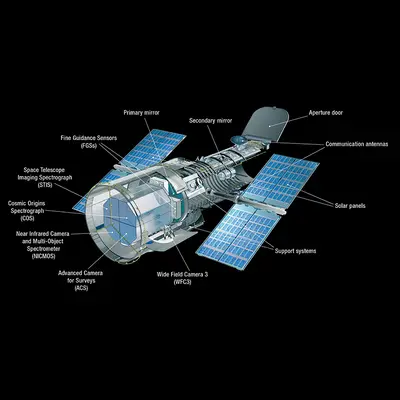
Astronomers Jay Anderson and Roeland van der Marel of the Space Telescope Science Institute analyzed archived Hubble observations of the stars at the center of Omega Centauri taken over four years, from 2002 to 2006, with the Advanced Camera for Surveys. They compared these sets of Hubble observations to measure the motions of more than 100,000 stars in the cluster. They then used the measurements to predict where the stars will go over the next 10,000 years.
Earlier research had suggested that there might be a black hole at the center of Omega Centauri. This seems unlikely, though, based on Anderson and van der Marel's study of the Hubble observations. The stars at the center of Omega Centauri are not traveling as they would if a massive black hole were gravitationally tugging on them, shepherding their movements.
Constellation: Centaurus
Distance: 16,000 light-years (4,800 parsecs)
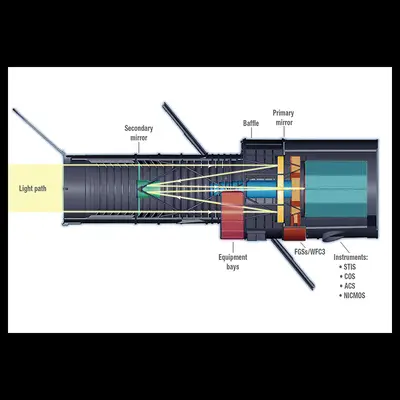
Instrument: Advanced Camera for Surveys and Wide Field Camera 3/UVIS
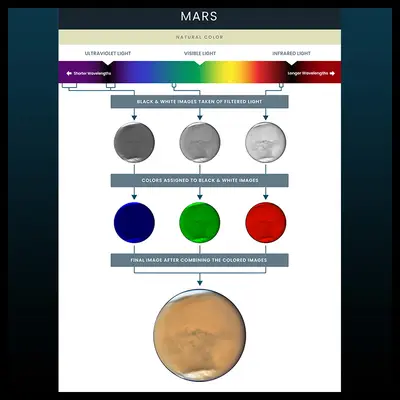
Image Filters: F225W (U), F275W (U), F336W (U), F438W (B), F606W (V), F814W (I)
Detalles de la imagen
| About The Object | |
|---|---|
| Object Name | Omega Centauri, NGC 5139 |
Descargas
Fuente
La imagen y el material de referencia se acreditan al archivo oficial de la misión enlazado a continuación.
Ver en NASA.gov