Archivo de imágenes de Hubble
Estrella devorando un planeta
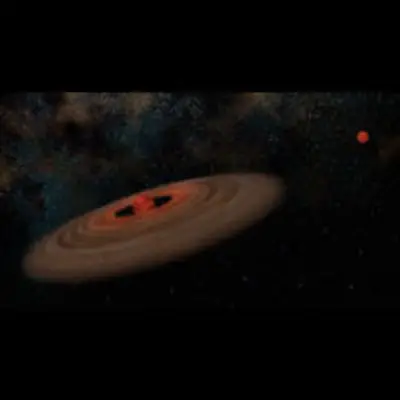
This is an artist's concept of the exoplanet WASP-12b. It is the hottest known planet in the Milky Way galaxy, and potentially the shortest lived. The planet is only 2 million miles from its sunlike parent star – a fraction of Earth's distance from the Sun. Gravitational tidal fo...
- Fecha
- Jan 1, 2010
- Misión
- Hubble Space Telescope
- ID de archivo
- hubblesite-images-2010-15-2725-image

This is an artist's concept of the exoplanet WASP-12b. It is the hottest known planet in the Milky Way galaxy, and potentially the shortest lived. The planet is only 2 million miles from its sunlike parent star – a fraction of Earth's distance from the Sun. Gravitational tidal forces from the star stretch the planet into an egg shape. The planet is so hot that it has puffed up to the point where its outer atmosphere spills onto the star. An accretion bridge streams toward the star and material is smeared into a swirling disk. The planet may be completely devoured by the star in 10 million years. The planet is too far away for the Hubble Space Telescope to photograph, but this interpretation is based in part on analysis of Hubble spectroscopic and photometric data.
Credits
Artwork: NASA, ESA, and G. Bacon (STScI);Science: NASA, ESA, and C. Haswell (The Open University, UK)
Detalles de la imagen
| About The Object | |
|---|---|
| Object Name | WASP-12b |
| Object Description | Planet around a nearby yellow dwarf star |
| R.A. Position | 06h 30m 32s.78 |
| Dec. Position | +29° 40' 20".3 |
| Constellation | Auriga |
| Distance | 600 light-years (184 parsecs) |
| About The Data | |
| Data Description | The data are from HST proposal : C. Haswell (The Open University), P. Wheatley (University of Warwick), L. Hebb and A. Cameron (University of St. Andrews), C. Froning (University of Colorado, Boulder), A. Carter (The Open University), B. Loeillet (Laboratoire d'Astrophysique de Marseille), C. Helling (University of St. Andrews), and L. Fossati (The Open University). |
| Instrument | HST>COS |
| Exposure Dates | Sept. 24-25, 2009, Exposure Time: Approx. 14,000 seconds total (approx. 4 hours) |
| Filters | NCM1, Grating: G285M |
Descargas
Fuente
La imagen y el material de referencia se acreditan al archivo oficial de la misión enlazado a continuación.
Ver en NASA.gov