Archivo de imágenes de Hubble
Centauro A: la historia interna
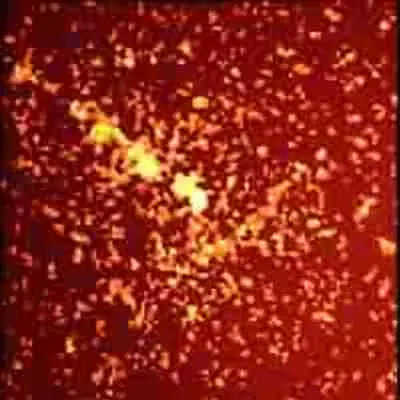
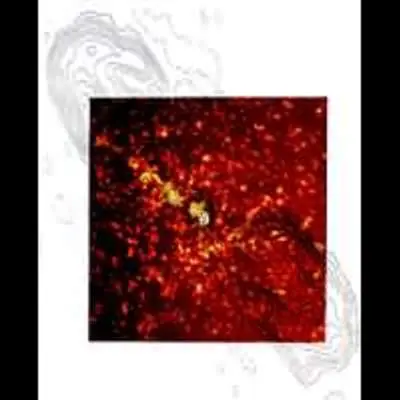
Astronomers have used NASA's Hubble Space Telescope to probe the core of the nearest active galaxy to Earth, Centaurus A.[UPPER LEFT] - A close-up high resolution Wide Field Planetary Camera 2 image of the dramatic dust disk which is thought to be the remnant of a smaller spiral...
- Fecha
- Jan 1, 1998
- Misión
- Hubble Space Telescope
- ID de archivo
- hubblesite-images-1998-14-648-image

Astronomers have used NASA's Hubble Space Telescope to probe the core of the nearest active galaxy to Earth, Centaurus A.
[UPPER LEFT] - A close-up high resolution Wide Field Planetary Camera 2 image of the dramatic dust disk which is thought to be the remnant of a smaller spiral galaxy that merged with the large elliptical galaxy. The shock of the collision compressed interstellar gas, precipitating a flurry of star formation and giving the material a fleecy pattern. Dark filaments of dust mixed with cold hydrogen gas are silhouetted against the incandescent yellow-orange glow from stars behind it.
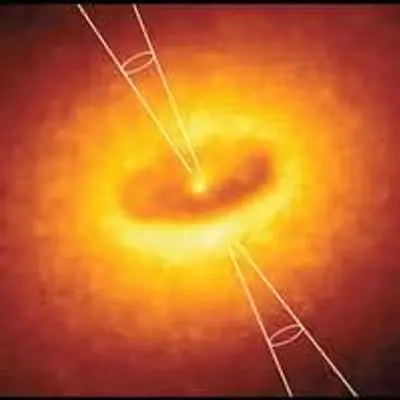
[LOWER RIGHT] - Hubble's Near Infrared Camera and Multi-Object Spectrometer was used to peer past the dust to discover a tilted disk of hot gas at the galaxy's center (white bar running diagonally across image center). This 130 light-year diameter disk encircles a suspected black hole which may be one billion times the mass of our Sun. The disk feeds material to presumably an inner, unresolved accretion disk that is made up of gas entrapped by the black hole. The red blobs near the disk are glowing gas clouds which have been heated up and ionized by the powerful radiation from the active nucleus.
The false-color NICMOS image was taken on Aug. 11, 1997 at a wavelength of 1.87 microns ("Paschen alpha"), characteristic of ionized Hydrogen.
Credits
E.J. Schreier (STScI) and NASA;Team members are: Ethan J. Schreier, Alessandro Marconi, David J. Axon, Nicola Caon, Duccio Macchetto ( STScI), Alessandro Capetti - (Osservatorio Astronomico di Torino, Italy), James H. Hough, Stuart Young ( University of Hertfordshire, UK), and Chris Packham (Isaac Newton Group, Islas Canarias, SPAIN)
Detalles de la imagen
| About The Object | |
|---|---|
| Object Name | Centaurus A, NG 5128 |
| Object Description | Active Galaxy |
| R.A. Position | 13h 25m 27.59s |
| Dec. Position | -47° 1' 9.0" |
| Constellation | Centaurus |
| Distance | 10 million light-years |
| Dimensions | 18.2 (arc minutes). Magnitude: 7.0 |
| About The Data | |
| Instrument | HST>WFPC2 (left), and HST>NICMOS (right) |
| Exposure Dates | August 1, 1997 and January 10, 1998 (WFPC2), and August 11, 1997 (NICMOS) |
| Filters | NICMOS: 1.87 microns (Paschen alpha) |
Más imágenes de este periodo
Descargas
Fuente
La imagen y el material de referencia se acreditan al archivo oficial de la misión enlazado a continuación.
Ver en NASA.gov