Archivo de imágenes de Hubble
Galaxias en el universo joven
[left] – This image of a small region of the constellation Sculptor, taken with a ground-based photographic sky survey camera, illustrates the extremely small angular size of a distant galaxy cluster in the night sky. Though this picture encompasses a piece of the sky about the w...
- Fecha
- Jan 1, 1994
- Misión
- Hubble Space Telescope
- ID de archivo
- hubblesite-images-1994-52-247-image

[left] – This image of a small region of the constellation Sculptor, taken with a ground-based photographic sky survey camera, illustrates the extremely small angular size of a distant galaxy cluster in the night sky. Though this picture encompasses a piece of the sky about the width of the bowl of the Big Dipper, the cluster is so far away it fills a sky area only 1/10th the diameter of the Full Moon. The cluster members are not visible because they are so much fainter than foreground stars.
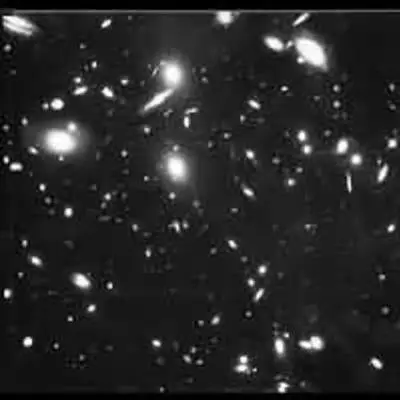
[center] – A NASA Hubble Space Telescope (HST) image of the farthest cluster of galaxies in the universe, located at a distance of 12 billion light-years. Because the light from these remote galaxies has taken 12 billion years to reach us, this image is a remarkable glimpse of the primeval universe, at it looked about two billion years after the Big Bang. The cluster contains 14 galaxies, the other objects are largely foreground galaxies. The galaxy cluster lies in front of quasar Q0000-263 in the constellation Sculptor. Presumably the brilliant core of an active galaxy, the quasar provides a beacon for searching for primordial galaxy clusters.
The image is the full field view of the Wide Field and Planetary Camera-2, taken on September 6, 1994. The 4.7-hour exposure reveals objects down to 28.5 magnitude.
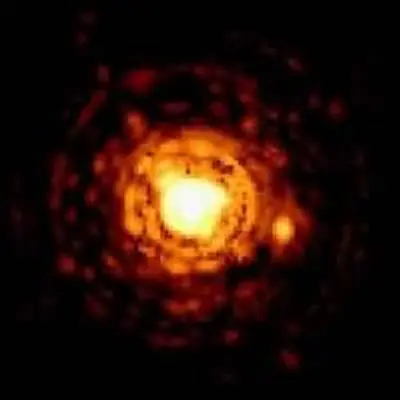
[right] – This enlargement shows one of the farthest normal galaxies yet detected, (blob at center right) at a distance of 12 billion light-years (redshift of z=3.330). The galaxy lies 300 million light-years in front of the quasar Q0000-263 (z=4.11, large white blob and spike on left side of frame) and was detected because it absorbs some light from the quasar. The galaxy's spectrum reveals that vigorous star formation is taking place.
Credits
Duccio Macchetto (ESA/STScI), Mauro Giavalisco (STScI), and NASADetalles de la imagen
| About The Object | |
|---|---|
| Object Name | Q0000-263 |
| R.A. Position | 00h 3m 22.9s |
| Dec. Position | -26° 3' 16.8" |
Fuente
La imagen y el material de referencia se acreditan al archivo oficial de la misión enlazado a continuación.
Ver en NASA.gov