Archivo de imágenes de Hubble
La Nebulosa del Huevo (CRL 2688) en luz visible (izquierda) e infrarroja (derecha)
The Egg Nebula, also known as CRL 2688, is shown on the left as it appears in visible light with the Hubble Space Telescope's Wide Field and Planetary Camera 2 (WFPC2) and on the right as it appears in infrared light with Hubble's Near Infrared Camera and Multi-Object Spectromete...
- Fecha
- Jan 1, 1997
- Misión
- Hubble Space Telescope
- ID de archivo
- hubblesite-images-1997-11-475-image

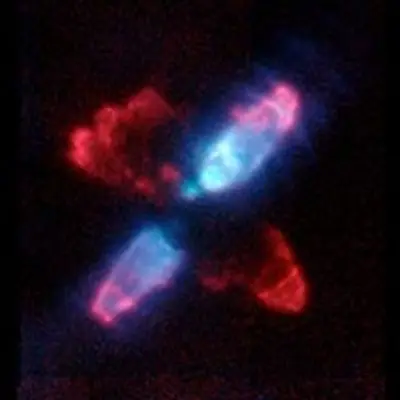
The Egg Nebula, also known as CRL 2688, is shown on the left as it appears in visible light with the Hubble Space Telescope's Wide Field and Planetary Camera 2 (WFPC2) and on the right as it appears in infrared light with Hubble's Near Infrared Camera and Multi-Object Spectrometer (NICMOS). Since infrared light is invisible to humans, the NICMOS image has been assigned colors to distinguish different wavelengths: blue corresponds to starlight reflected by dust particles, and red corresponds to heat radiation emitted by hot molecular hydrogen.
Objects like the Egg Nebula are helping astronomers understand how stars like our Sun expel carbon and nitrogen – elements crucial for life – into space. Studies on the Egg Nebula show that these dying stars eject matter at high speeds along a preferred axis and may even have multiple jet-like outflows. The signature of the collision between this fast-moving material and the slower outflowing shells is the glow of hydrogen molecules captured in the NICMOS image.
The distance between the tip of each jet is approximately 200 times the diameter of our solar system (out to Pluto's orbit).
Credits
Rodger Thompson, Marcia Rieke, Glenn Schneider, Dean Hines (University of Arizona); Raghvendra Sahai (Jet Propulsion Laboratory); NICMOS Instrument Definition Team, and NASADetalles de la imagen
| About The Object | |
|---|---|
| Object Name | Egg Nebula, CRL 2688 |
| R.A. Position | 21h 2m 18.79s |
| Dec. Position | 36° 41' 38.0" |
Descargas
Fuente
La imagen y el material de referencia se acreditan al archivo oficial de la misión enlazado a continuación.
Ver en NASA.gov