Archivo de imágenes de Hubble
El anillo de la supernova 1987A vuelve a la vida
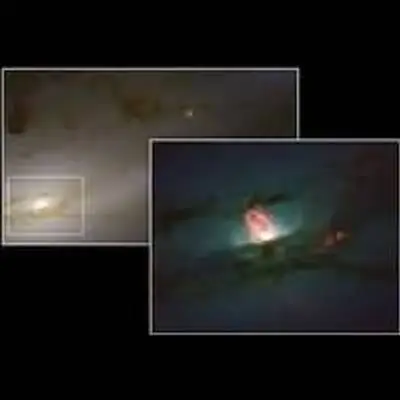
[Left] – This NASA Hubble Space Telescope Wide Field and Planetary Camera 2 image shows the glowing gas ring around supernova 1987A, as seen on February 2, 2000. The gas, excited by light from the explosion, has been fading for a decade, but parts of it are now being heated by th...
- Fecha
- Jan 1, 2000
- Misión
- Hubble Space Telescope
- ID de archivo
- hubblesite-images-2000-11-953-image

[Left] – This NASA Hubble Space Telescope Wide Field and Planetary Camera 2 image shows the glowing gas ring around supernova 1987A, as seen on February 2, 2000. The gas, excited by light from the explosion, has been fading for a decade, but parts of it are now being heated by the collision of an invisible shockwave from the supernova explosion.
[Right] – Image processing is used to emphasize four new bright knots of superheated gas discovered in the February 2 Hubble observations. The brightest knot, at the far right, was seen in 1997. Astronomers have been waiting several years to see more of the ring light-up as the supernova shockwave smashes into it. This is the first definitive sign of the full onset of a dramatic and violent collision which will continue over the next few years, rejuvenating SN1987A as a powerful source of X-ray and radio emissions.
Both images were made in visual light. Computer image processing techniques were used to enhance details in the ring.
Credits
NASA, Peter Challis and Robert Kirshner (Harvard-Smithsonian Center for Astrophysics), Peter Garnavich (University of Notre Dame), and the SINS CollaborationDetalles de la imagen
| About The Object | |
|---|---|
| Object Name | SN 1987A |
| R.A. Position | 05h 35m 28.25s |
| Dec. Position | -69° 16' 13.0" |
Descargas
Fuente
La imagen y el material de referencia se acreditan al archivo oficial de la misión enlazado a continuación.
Ver en NASA.gov