Archivo de imágenes de Hubble
El Telescopio Espacial Hubble de la NASA fotografía la aurora de Júpiter
The image at top right shows Jovian aurora observed on February 8, 1992, by the European Space Agency's Faint Object Camera (FOC) aboard NASA's Hubble Space Telescope (HST). This is the first direct image of the aurora taken in ultraviolet light (1600 Angstroms) and the best auro...
- Fecha
- Jan 1, 1992
- Misión
- Hubble Space Telescope
- ID de archivo
- hubblesite-images-1992-13-62-image
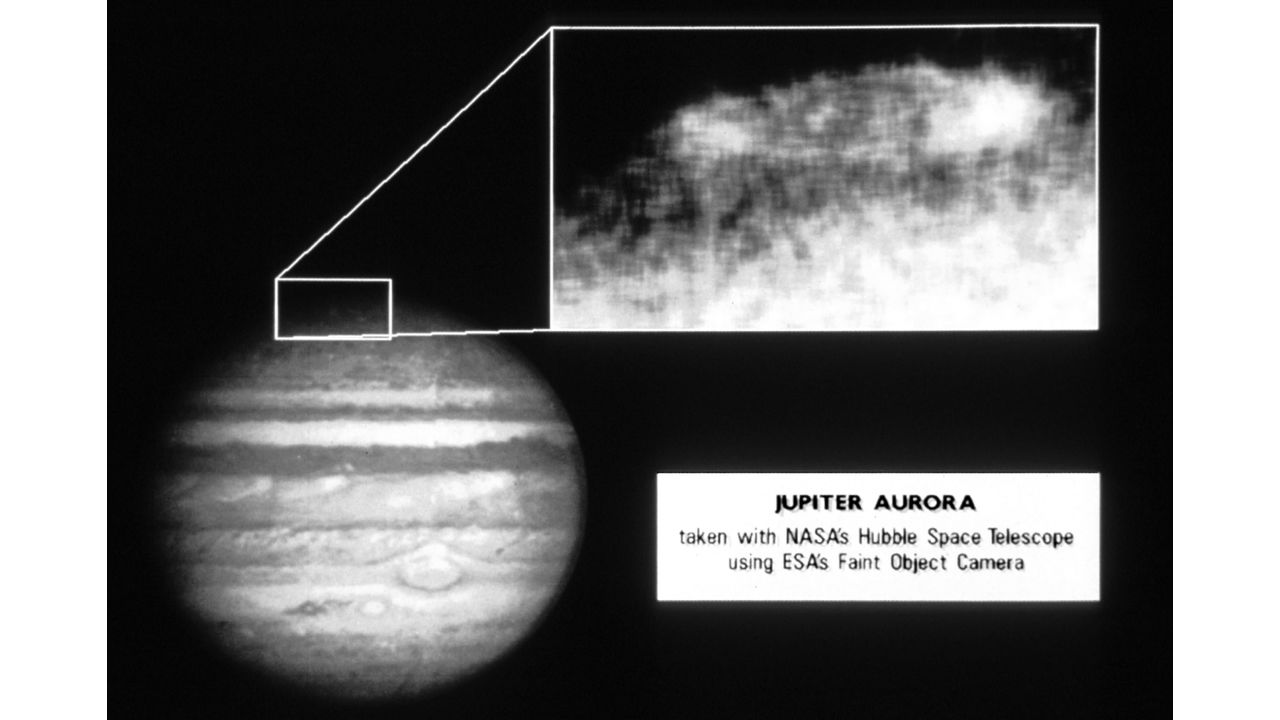
The image at top right shows Jovian aurora observed on February 8, 1992, by the European Space Agency's Faint Object Camera (FOC) aboard NASA's Hubble Space Telescope (HST). This is the first direct image of the aurora taken in ultraviolet light (1600 Angstroms) and the best auroral images ever. An earlier image of Jupiter's full disk (lower left), obtained by HST's Wide Field/Planetary Camera, shows the location of the northern aurora (box) with respect to the rest of the planet.
The FOC image shows the aurora is not uniformly bright, but rather there is a region of significantly increased brightness toward the west (right) side. This effect has not yet been explained fully.
The bright oval shape of the aurora corresponds approximately to the position where magnetic field lines passing through the orbit of the Jovian satellite, Io, enter Jupiter's atmosphere. This is strong circumstantial evidence that Io is the source of the particles that cause the aurora. In 1980, Voyager discovered that Io has an extraordinarily active volcano system, and many observations have determined that volcanic particles escape from Io into the Jovian magnetosphere.
HST observations were made simultaneously with the Jupiter flyby of the NASA/ESA Ulysses spacecraft. (Ulysses flew by Jupiter to be gravitationally boosted onto a trajectory that will carry it over the Sun's southern pole. While at Jupiter, Ulysses took advantage of the opportunity to make measurements of the Jovian magnetosphere. Ulysses does not have an onboard camera.)
The aurora provides useful information about Jupiter's magnetic field and how high energy particles from the magnetosphere influence the temperature, chemical composition and winds at the planet's northern pole.
Credits
John Caldwell, Institute for Space and Terrestrial Science, and York University; and NASA/ESADetalles de la imagen
| About The Object | |
|---|---|
| Object Name | Jupiter |
Descargas
Fuente
La imagen y el material de referencia se acreditan al archivo oficial de la misión enlazado a continuación.
Ver en NASA.gov