Archivo de imágenes de Hubble
NICMOS: Más de 300 galaxias débiles
[Left] A NASA Hubble Space Telescope view of the faintest galaxies ever seen in the universe, taken in infrared light with the Near Infrared Camera and Multi-Object Spectrometer (NICMOS).The picture contains over 300 galaxies having spiral, elliptical and irregular shapes. Though...
- Fecha
- Jan 1, 1998
- Misión
- Hubble Space Telescope
- ID de archivo
- hubblesite-images-1998-32-709-image

[Left] A NASA Hubble Space Telescope view of the faintest galaxies ever seen in the universe, taken in infrared light with the Near Infrared Camera and Multi-Object Spectrometer (NICMOS).
The picture contains over 300 galaxies having spiral, elliptical and irregular shapes. Though most of these galaxies were first seen in 1995 when Hubble was used to take a visible-light deep exposure of the same field, NICMOS uncovers many new objects. Most of these objects are too small and faint to be apparent in the full field NICMOS view.
Some of the reddest and faintest of the newly detected objects may be over 12 billion light-years away, as derived from a standard model of the universe. However, a powerful new generation of telescopes will be needed to confirm the suspected distances of these objects.
The field of view is 2 million light-years across, at its maximum. Yet, on a cosmic scale, it represents only a thin pencil beam look across the universe. The area of sky is merely 1/100th the apparent diameter on the full moon.
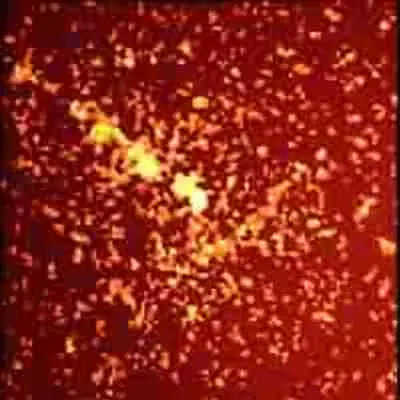
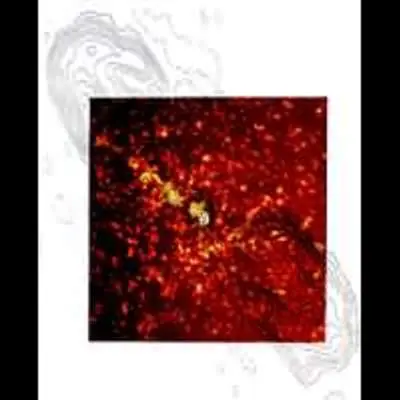
[Right] Two close-up NICMOS views of candidate objects which may be over 12 billion light-years away. Each candidate is centered in the frame. The reddish color may mean all of the starlight has been stretched to infrared wavelengths by the universe's expansion. Alternative explanations are that the objects are closer to us, but the light has been reddened by dust scattering. A new generation of telescopes will be needed to make follow-up observations capable of establishing true distance.
The image was taken in January 1998 and required an exposure time of 36 hours to detect objects down to 30th magnitude. Hubble was aimed in the direction of the constellation Ursa Major, in a region just above the handle of the Big Dipper. The color corresponds to blue (0.45 microns), green (1.1 microns) and red (1.6 microns).
Credits
Rodger I. Thompson (University of Arizona) and NASADetalles de la imagen
| About The Object | |
|---|---|
| Object Name | HDF-N |
| R.A. Position | 12h 36m 48.26s |
| Dec. Position | 62° 13' 1.99" |
Más imágenes de este periodo
Descargas
Fuente
La imagen y el material de referencia se acreditan al archivo oficial de la misión enlazado a continuación.
Ver en NASA.gov