Archivo de imágenes de Hubble
Imágenes del Telescopio Espacial Hubble de una Estrella Brillante en la Gran Nube de Magallanes
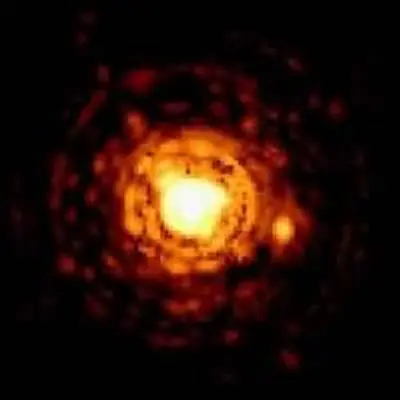
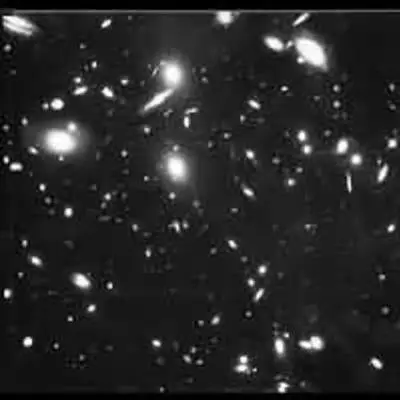
The three panels show images of a very bright (Wolf-Rayet) star, Melnick 34, located in the giant star-forming region called 30 Doradus in the Large Magellanic Cloud. In the background are a number of fainter stars that are comparable in brightness to our Sun.[Left] Ground Based...
- Fecha
- Jan 1, 1994
- Misión
- Hubble Space Telescope
- ID de archivo
- hubblesite-images-1994-05-131-image

The three panels show images of a very bright (Wolf-Rayet) star, Melnick 34, located in the giant star-forming region called 30 Doradus in the Large Magellanic Cloud. In the background are a number of fainter stars that are comparable in brightness to our Sun.
[Left] Ground Based View
The best available ground-based image of Melnick 34 (Courtesy Dr. Georges Meylan of the European Southern Observatory). This image was taken under ideal atmospheric conditions when the width of a star image was about 0.6 arc seconds.
[Middle] WF/PC-1 Image
The same field, as imaged by the first Wide Field and Planetary Camera (WF/PC-). The advantages of working in space above Earth's distorting atmosphere are immediately apparent. Atmospheric blurring is gone and many more stars are visible. However, the effects of the Hubble Telescope's spherical aberration also are apparent. In particular there is a four arc second diameter "skirt" around the bright star which obscures the view of the sky in its vicinity. It is very hard to do quantitative measurements on such an image because of the way the light from many stars overlaps.
[Right] WFPC-2 Image
An image of the same field, made with the new Wide Field and Planetary Camera's (WFPC-2) improved optics. With an exposure equivalent to the WF/PC-1 image, this WFPC-2 image collects all the light from the central star into sharp focus because the telescope's spherical aberration is corrected by the new camera's optics. A large number of fainter stars also become visible. This is because all of their light is concentrated, and enough is gathered to make them visible above the intrinsic noise from the instrument and sky. In the WF/PC-1 image, enough light is distributed in the image "skirt that background stars become lost in the noise. In WFPC-2, not only are the fainter stars visible, but quantitative measurements of their brightness also are possible.
By facilitating quantitative measurements in faint and crowded star fields, the Wide Field and Planetary Camera-2 and the Hubble Space Telescope will be able to address all the key programs for which the telescope and instrument were originally designed.
Detalles de la imagen
| About The Object | |
|---|---|
| Object Name | Melnick 34, 30 Doradus |
| R.A. Position | 05h 38m 42.39s |
| Dec. Position | -69° 6' 2.81" |
Fuente
La imagen y el material de referencia se acreditan al archivo oficial de la misión enlazado a continuación.
Ver en NASA.gov