Archivo de imágenes de Hubble
Primer plano de M27, la Nebulosa Dumbbell
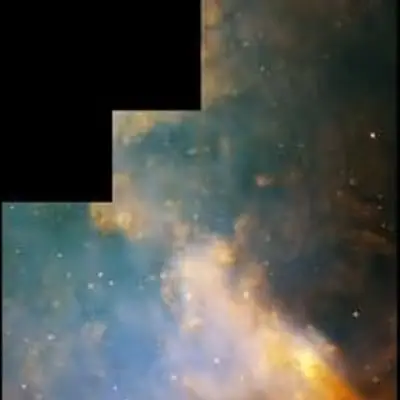
An aging star's last hurrah is creating a flurry of glowing knots of gas that appear to be streaking through space in this close-up image of the Dumbbell Nebula, taken with NASA's Hubble Space Telescope.The Dumbbell, a nearby planetary nebula residing more than 1,200 light-years...
- Fecha
- Jan 1, 2003
- Misión
- Hubble Space Telescope
- ID de archivo
- hubblesite-images-2003-06-1295-image

An aging star's last hurrah is creating a flurry of glowing knots of gas that appear to be streaking through space in this close-up image of the Dumbbell Nebula, taken with NASA's Hubble Space Telescope.
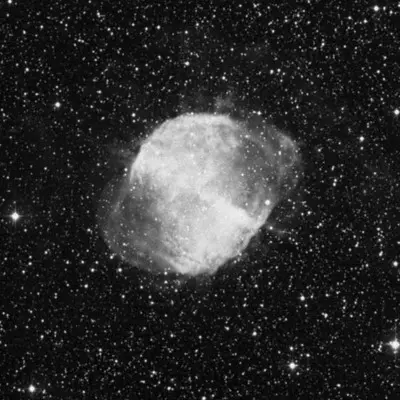
The Dumbbell, a nearby planetary nebula residing more than 1,200 light-years away, is the result of an old star that has shed its outer layers in a glowing display of color. The nebula, also known as Messier 27 (M27), was the first planetary nebula ever discovered. French astronomer Charles Messier spotted it in 1764.
The Hubble images of the Dumbbell show many knots, but their shapes vary. Some look like fingers pointing at the central star, located just off the upper left of the image; others are isolated clouds, with or without tails. Their sizes typically range from 11 - 35 billion miles (17 - 56 billion kilometers), which is several times larger than the distance from the Sun to Pluto. Each contains as much mass as three Earths.
The knots are forming at the interface between the hot (ionized) and cool (neutral) portion of the nebula. This area of temperature differentiation moves outward from the central star as the nebula evolves. In the Dumbbell astronomers are seeing the knots soon after this hot gas passed by.
Dense knots of gas and dust seem to be a natural part of the evolution of planetary nebulae. They form in the early stages, and their shape changes as the nebula expands. Similar knots have been discovered in other nearby planetary nebulae that are all part of the same evolutionary scheme. For example, they can be seen in Hubble telescope photos of the Ring Nebula (NGC 6720) and the Retina Nebula (IC 4406). The detection of these knots in all the nearby planetaries imaged by the Hubble telescope allows astronomers to hypothesize that knots may be a feature common in all planetary nebulae.
This image, created by the Hubble Heritage Team (STScI), was taken by Hubble's Wide Field Planetary Camera 2 in November 2001, by Bob O'Dell (Vanderbilt University) and collaborators. The filters used to create this color image show oxygen in blue, hydrogen in green and a combination of sulfur and nitrogen emission in red.
Credits
NASA and The Hubble Heritage Team (STScI/AURA);Acknowledgment: C.R. O'Dell (Vanderbilt University)
Detalles de la imagen
| About The Object | |
|---|---|
| Object Name | Dumbbell Nebula, M27, NGC 6853 |
| Object Description | Planetary Nebula |
| R.A. Position | 19h 59m 36.26s |
| Dec. Position | 22° 43' 15.6" |
| Constellation | Vulpecula |
| Distance | 1240 light-years (380 parsecs) |
| Dimensions | The image is roughly 2.1 arcminutes (0.8 light-years or 48,000 Astronomical Units) in width. |
| About The Data | |
| Data Description | Principal Astronomers: C.R. O'Dell (Vanderbilt University), B. Balick (U. Washington), A. Burkert (Max Planck Institute for Astronomy-Heidelberg), A. Hajian (USNO), W. Henney (UNAM, Morelia) |
| Instrument | HST>WFPC2 |
| Exposure Dates | November 19, 2001, Exposure Time: 2.4 hours |
| Filters | F502N ([O III]), F547M (Strömgren y), F656N (H-alpha), F658N ([N II]), F673 ([S II]) |
Descargas
Fuente
La imagen y el material de referencia se acreditan al archivo oficial de la misión enlazado a continuación.
Ver en NASA.gov