Archivo de imágenes de Hubble
Los arcos y los cúmulos quintillizos cerca del centro galáctico de la Vía Láctea
Penetrating 25,000 light-years of obscuring dust and myriad stars, NASA's Hubble Space Telescope has provided the clearest view yet of a pair of the largest young clusters of stars inside our Milky Way galaxy, located less than 100 light-years from the very center of the Galaxy....
- Fecha
- Jan 1, 1999
- Misión
- Hubble Space Telescope
- ID de archivo
- hubblesite-images-1999-30-863-image

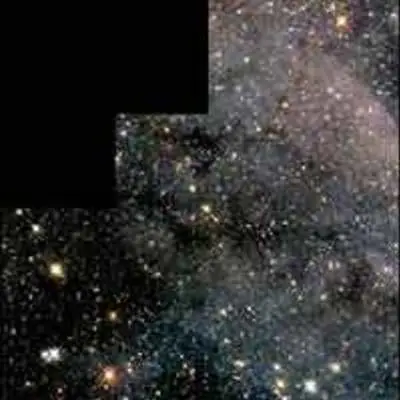
Penetrating 25,000 light-years of obscuring dust and myriad stars, NASA's Hubble Space Telescope has provided the clearest view yet of a pair of the largest young clusters of stars inside our Milky Way galaxy, located less than 100 light-years from the very center of the Galaxy. Having the equivalent mass greater than 10,000 stars like our sun, the monster clusters are ten times larger than typical young star clusters scattered throughout our Milky Way. Both clusters are destined to be ripped apart in just a few million years by gravitational tidal forces in the Galaxy's core. But in the brief time they are around, they shine more brightly than any other star cluster in the Galaxy.
Arches cluster (left): The more compact Arches cluster is so dense, over 100,000 of its stars would fill a spherical region in space whose radius is the distance between the Sun and its nearest neighbor, the star Alpha Centauri, 4.3 light-years away. At least 150 of its stars are among the brightest ever seen in the Galaxy.
Quintuplet cluster (right): This 4-million-year-old cluster is more dispersed than the Arches cluster. It has stars on the verge of blowing up as supernovae. It is the home of the brightest star seen in the Galaxy, called the Pistol star.
Both pictures were taken in infrared light by Hubble's NICMOS camera in September 1997. The false colors correspond to infrared wavelengths. The galactic center stars are white, the red stars are enshrouded in dust or behind dust, and the blue stars are foreground stars between us and the Milky Way's center.
The clusters are hidden from direct view behind black dust clouds in the constellation Sagittarius. If the clusters could be seen from Earth they would appear to the naked eye as a pair of third magnitude "stars," 1/6th of a full moon's diameter apart.
Credits
Don Figer (STScI) and NASADetalles de la imagen
| About The Object | |
|---|---|
| Object Name | Arches Cluster, Quintuplet Cluster |
| Object Description | Star Clusters |
| Constellation | Sagittarius |
| About The Data | |
| Data Description | F110W (J-band), F160W (H-band), F187N (Paschen-alpha), and F205W (205nm) |
Descargas
Fuente
La imagen y el material de referencia se acreditan al archivo oficial de la misión enlazado a continuación.
Ver en NASA.gov